Showing posts with label Sugar. Show all posts

Thursday, July 7, 2011

India sugar prices july 7 2011: sugar industry needs de-regulation

India_Sugar__ISMA
India sugar prices july 7 2011: sugar industry needs de-regulation | Agricultural Commodities Prices | Building cane price arrears will also harm the farmers, who he feared would move away from sugarcane cultivation in 2012-13. With increase in domestic demand, the country will then be forced to import at high prices, Murkumbi said. He said in the sugar season 2009-10, around Rs 45,000 crore was paid to farmers as cane price, this year it is expected to rise to about Rs 51,000 crore. However, the industry continued to be controlled by the government which was harming the industry, he claimed. 

Certain percentage of sugar produced had to be handed over to the government at a given price for public distribution system. Such a practise was not followed in other parts of the world, he said. The government, he said, must procure sugar at the market price and then make it available to the PDS at a subsidised rate, to safeguard the interest of sugar producers. Sugar prices in India were 30 per cent lower than global prices, he added. The ISMA demanded abolition of levy sugar obligation on sugar mills and of monthly regulated release mechanism. It also demanded fast-tracking of the national ethanol programme. He said around 600,000 tons of molasses had to be exported as it could not be sold. If this had been converted into ethanol, it could have addressed one per cent of the country''s petrol requirement. | Agricultural Commodities Prices |

Monday, June 27, 2011

Sugar, a source of carbohydrates for human

Sugar-agriculture_commodities
Sugar, a source of carbohydrates for human | agriculture commodities - commodity prices - food sciences | Sugar is a term for a type of edible crystalline carbohydrates, mainly sucrose, lactose and fructose, which is characterized by a sweet taste. In the product of foods, sugar is almost exclusively refering to sucrose, which is completely refined (free sugar) form, which is mainly from sugar cane and sugar beets, even if are present in natural form in many carbohydrates. Other free sugars are used in industrial food preparation, but generally known as the more specific names - glucose, fructose, fruit sugar, high fructose corn syrup, etc.

Currently, Brazil is the largest sugar producer in the world.

Sugar, because of its simple chemical structure, it was assumed (without research) to raise blood glucose levels more rapidly than starch, but the results of more than twenty studies have shown that sugar and starch cause an increase blood glucose in similar rates. This has shown that control of all carbohydrates are needed to control blood sugar in diabetics, the idea behind the calculation of carbohydrates. Some experts believe that consuming excessive amounts of sugar does not increase the risk of diabetes, although the excess of calories to consume large amounts of sugar can lead to obesity, which can increase the risk of diabetes.

But a 2010 meta-analysis of eleven trials with 310,819 participants and 15,043 cases of type 2 diabetes found that "SSBs(sugar sweetened beverages) may increase the risk of [metabolic syndrome] and type 2 diabetes-not only obesity, but also by increasing the dietary glycemic load, which leads to insulin resistance, β cell dysfunction, and inflammation. "

As an overview of chronic illnesses associated with consumption and obesity, independent of the WHO meta-studies specifically distinguish between free sugars ("all monosaccharides and disaccharides added to foods by the manufacturer, cook or the consumer, plus sugars naturally present in honey, syrups and fruit juices "), sugars naturally present in food.

Reports before 2000, the limits on free sugars is less than 10% carbohydrate intake, in terms of energy, rather than mass, and since 2002 has been directed at the total population of less than 10%. consultation Committee recognized that this goal is "controversial. However, the consultation noted that studies show no effect of free sugars is too much emphasis on the restrictions." (P57).

While contribution sugar to dental caries, sugar-free is also recommended to be less than 10%. There are " convincing evidences of human intervention studies, epidemiological studies and animal experiments, and the association between the number and frequency of sugar intake and tooth decay", while other sugars (complex-carbohydrates) consumption is usually associated with a lower tooth decay. Reduction of  tooth caries was observed in subjects with hereditary fructose intolerance. @ agriculture commodities

Monday, June 20, 2011

Sugar market news june 20 2011, commodity prices

Sugar market news june 20 2011, commodity prices - Hungary "chips tax" to soup up black market, fuel tax evasion: The public health product fee, which was previously dubbed "hamburger tax" and now "chips tax" is to be payable by the business that first starts to market the product in Hungary (it could be the producer itself if it is domestic or the importer is the product is made abroad). The fee will be slapped on products, the sugar, salt or caffeine content of which exceeds the threshold set by law. The products affected are to be soft drinks, energy drinks, sweets, ice creams, ice-lolly, popsicles, salted snacks and food powders.

The OKSZ projects that the consumer price of these products will rise and consequently their sales (calculated in litre, weight or unit) will decline. This is what the very objective of healthy policy should be, it said, adding that the bigger the product fee is, the more dramatic the decrease will be.

The producers will find substitute products that are exempt from the tax, the association forecasts. The levy, however, is to "increase profiteering and tax evasion related to these products" and "Hungarians will buy more (of these products) abroad - especially travellers and those living in border towns".

While the OKSZ believes the product fee will boost budget revenues that may be spent on healthcare purposes, but "by a lot less than what the government hopes." The association does not believe considerable extra revenues could be made by this levy, saying what will be gained on one side, will be lost on the other (e.g. VAT).

tags: sugar, market, commodities, sugar market, commodities market, commodity prices, sugar prices,

Saturday, June 18, 2011

Bullish and Bearish Factors of Sugar Commodity Prices, June 18

Bullish and Bearish Factors of Sugar Commodity Prices, June 18 - Sugar prices rose to a 2-month high but remain well below Feb's 30-yr high. Bullish factors include (1) export delays in Brazil where as many as 68 vessels were waiting to load about 2.22MMT of sugar, according to shipping agency Williams Servicos Maritimos, (2) USDA forecasts for record global sugar consumption in 2011-12 of 162 MMT, and (3) reduced output in Australia, the third largest sugar exporter, after floods and cyclones may cut its sugar output to a 9-yr low of 3.58 MMT and may reduce its sugar output for the next 2-3 years.

Bearish factors include (1) ISO's estimate for a 4 MMT global sugar surplus in 2011-12 on increased production in Brazil and India, and (2) ISO's hike in its global sugar surplus estimate for 2010-11 to 1 MMT from a Feb estimate of 200,000 tons on higher output from Thailand and India.


Fundamental Outlook-Bull market correction-Sugar prices remain in correction mode as the USDA raised its global sugar output estimates for next year and ISO raised its global surplus estimates, but the longer-term outlook remains bullish on tight supply channels and the outlook for reduced output in Australia. ISO is forecasting a 1 MMT global sugar surplus for 2010/11 after 2-yrs of deficits. ISO is also forecasting a 1.7% rise in global sugar demand this year that will cut the inventory-to-consumption ratio to a 20-yr low of 32%.

Related posts:

Wednesday, October 20, 2010

Trends, Hurdles, and Potentials of Biofuel

Algae based biodiesel might be the futu
Trends, Hurdles, and Potentials of Biofuel - Recent development in the biofuel market. Few people interested in green technology have missed the large fuss regarding algae biodiesel production from microalgae considered by many the only alternative with potential of replacing the entire world consumption of fossil fuels by its own. It is still quite expensive but bioengineering and more efficient production swiftly reduces the gap. A researcher and friend of mine calculated that 76x76 km area of algae production would cover the entire fuel consumption needed for Sweden.

Early 2008 Solazyme, which uses algae fermentation to make oil from sugar crops, got Chevron as investor and recently they was contracted by the Us Navy for producing 1500 Gallons of Jet Fuel and another 150000 Gallons of biodiesel for the navy ships. Us is considering the dependence of foreign fuel deliveries as a national security and set the navy target to 50% biofuels in 2020.

The Energy company St1 recently made an interesting move in Sweden when buying up gas stations, now roughly 200 stations, providing self made bioethanol produced from rest products of the food production industry.

Algae based biodiesel might be the future

The biodiesel industry are also foreseeing a brighter future now when the amount of biodiesel now blended into normal diesel is now up at 5%. US ethanol blending limit is also considered to be raised from 10% to up to 15% in the near future that will boost the US Corn based bio ethanol and in Brazil they had to lower their ethanol-gas blend to 20% from 25% for some time because they could not produce enough of their sugar cane based bioethanol.

Early 2010 Solena Group that uses a 5000 degree plasma torch to produce synthetic biogas from algae biomass teamed up with Brittish airways to fuel aircrafts by 2014 and also Russia is moving forward by starting up a cellulose based biobuthanol plant. Read here

Last prognosis from Lux Research says that that the biofuel production will increase from todays 3% of total production by 7.8% yearly until 2015 and that the most rapid areas will be in Jet-Fuels, biodiesel and algae oil.

Biofuel hurdles

Biofuels have a big hurdle which is the infrastructure and compatibility in the machines that use them. Changing this is something that takes a long time, requires lots of politics and requires large daring investments in machines powered by fuels that not certainly will be the preferred ones. Once a standard has been established the competitive technology needs to be much better in order to break through. This might be ok with electric cars since you can charge them at home but for fuel cells for example it might be difficult unless we have our own hydrogen producing electrolyzers at home.

As many other, BP saw this hurdle earlier and their tactics together with DuPont is to make biobutanol and blend normal gasoline with up to 15% of it to be used in all the cars and fuel stations that already exist.

In Sweden we saw a big boost for biogas earlier and many car makers raced to launch their flexifuel gas-diesel and gas-gasoline hybrids to match the anticipated improvement of biogas infrastructure. This however halted somewhat and the preferred choice became ethanol leaving many frustrated new biogas car owners.

First generation biofuel

Sugar cane field in brazil for
bioethanol production
First generation is a composition of all the fuels produced by feedstock from the normal food chain. Fermentation of sugar rich biomass like sugar cane in Brasil to Corn in US to produce bioethanol or vegetable oil from sunflowers to produce biodiesel in Europe. The processes are standard and the crops are easy to grow but the downsides are many including increased food prices, deforestation and sometimes a questionable life cycle green house gas savings compared too fossil fuels.

This generation has a huge advantage though because it it is first. It is already established with rapidly increasing volumes and reduced cost and it is easy to set up production of in many countries that needs an extra economy boost. Despite the downsides I believe that the following generations will have a steep uphill run compared to this because of the mentioned advantages unless there are political incentives leveling the rules. Green business will never fly just because it is green because it has to give the consumer an advantage of lower price or enabling some other applications as any other product.

Below is a trend chart of the larger movements in the biodiesel and bioethanol industry. Its obvious that Brasil is quite aggressive in this area.

Global biofuel production distribution
Biogas is also part of first generation fuels and is normally defined as a gas produced by the biological breakdown of organic matter in the absence of oxygen. Biogas production has a big benefit that it can use many types of waste and create a use for all our landfills. It can also be produced very locally and since the anaerobic process is very simple it can also be used in very small production sites like farms enabling local energy and fuel production which is very nice.

Biogas can also be created from algae biomass which sometimes is referred to green gas and has the additional advantage of the rapid growth of algae biomass that is typically 20-100 times faster than other land based crops. Seen from a greenhouse gas life cycle perspective biogas is first in class.

Biogas production video

Second generation biofuel

Poplar for lignocellulosic
biofuel production
Second generation biofuel is the common name for biofuel production using lignocellulosic crops like wood as an example where you split the biomass typically by enzymes into cellulose (42%), hemicellulose (21%) and lignin and assuming full conversion to sugar of the both cellulose variants to sugar it can be used to create 30% ethanol by common fermentation as in making beer. The rest product lignin is now used mostly burned up to provide heat but here there are many interesting areas being evolved like creating lignin based plastics.

The second generation has large advantages over Sugar & Starch crops based production since it it is much more Green house gas efficient (90% saving compared to fossil fuels) and used the leftovers in food production and not the food itself.

Lignocellolosic ethanol production video

Third generation biofuel

During the oil crisis in the 1970s there was huge fundings of research in the field of algae based biofuels sponsored by the Carter administration, however when Clinton entered the scene the oil price was lower and funding stopped. There was however a very large knowledge base built up that was the start of many of the companies that we see today, many with investment from the large oil companies.

Those algae based biofuels now goes under the term third generation biofuel. It has the benefits of producing biomass very fast, 20-100 times faster than land based crops and there is lots of space to grow them. The production either uses algae with high concentration of oil to be converted to biodiesel, or using the upside of the fastest growing algae variants to create large biomass for gas production.

Third generation algae based biofuel
The downsides are mostly connected to its immaturity. For example producing the oil based diesel is still 3 times higher than biodiesel based on palm oil but in time this will probably be solved. The cost of producing biodiesel from algae is currently 52.3 Euro per gigajoule of energy, compared with 36 Euro for rapeseed and only 15.8 Euro for Oil. Also algae for gas production has challenges with predators and harvesting difficulties, however this seem to be an easier challenge and may quickly be solved with increased production.

The algae growth can be done in the open sea, closed ponds or in dedicated bioreactors like very long transparent tubes.

Video showing an algae bioreactor:

Fourth generation?

Well there are many speculations what the fourth generation may be but one of the challenges of the current solutions is that all of them requires many steps to reach the final fuel and maybe this is what will be solved in the future, likely by more advanced genetics and bioengineering.

In September the Cambridge based startup Joule said that they had engineered a blue-green algae that could convert Carbon dioxides in glass bioreactors with only sunlight as source. Well if this is sci-fi or not is yet to be seen but the thought is pleasant. For anyone that has some time left you can read the patent here and here is an article from cnet that discusses this in more detail.

Retrieved from: The Green Technology

Tuesday, October 12, 2010

About Sugarcane

About Sugarcane - Sugarcane is any of six to thirty-seven species (depending on taxonomic system) of tall perennial grasses of the genus Saccharum (familyPoaceae, tribe Andropogoneae). Native to warm temperate to tropical regions of Asia, they have stout, jointed, fibrous stalks that are rich insugar, and measure two to six meters (six to nineteen feet) tall. All sugar cane species interbreed, and the major commercial cultivars are complex hybrids.
Today, sugarcane is grown in over 110 countries. In 2008 an estimated 1,743 million metric tons were produced worldwide, with about 50 percent of production occurring in Brazil and India.
Sugar cane products include table sugar, Falernum, molasses, rum, cachaça (the national spirit of Brazil), and ethanol. The bagasse that remains after sugar cane crushing may be burned to provide heat and electricity. It may also, because of its high cellulose content, serve as raw material for paper, cardboard, and eating utensils that, because they are by-products, may be branded as "environmentally friendly". 

History of sugarcane

Sugarcane is indigenous to tropical South Asia and Southeast Asia.Different species likely originated in different locations with S. barberioriginating in India and S. edule and S. officinarum coming from New Guinea. Crystallized sugar was reported 5,000 years ago in India.
Around the eighth century A.D., Indian traders introduced sugar to the Mediterranean, Mesopotamia, Egypt, North Africa, and Andalusia. By the tenth century, sources state, there was no village in Mesopotamia that did not grow sugar cane. It was among the early crops brought to the Americas by theAndalusians (from their fields in the Canary Islands), and the Portuguese.
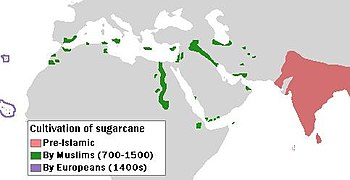
The westward diffusion of sugarcane in pre-Islamic
times (shown in  red), in the medieval Muslim world
(green) and by Europeans (violet)
[2]
"Boiling houses" in the 17th through 19th centuries converted sugarcane juice into raw sugar. These houses were attached to sugar plantations in the western colonies. Slaves often ran the boiling process, under very poor conditions. Made of cut stone, rectangular boxes of brick or stone served as furnaces with an opening at the bottom to stoke the fire and remove ashes. At the top of each furnace were up to seven copper kettles or boilers, each one smaller and hotter than the previous one. The cane juice began in the largest kettle. The juice was then heated and lime added to remove impurities. The juice was skimmed, then channeled to successively smaller kettles. The last kettle, which was called the 'teache', was where the cane juice became syrup. The next step was a cooling trough, where the sugar crystals hardened around a sticky core of molasses. This raw sugar was then shoveled from the cooling trough into hogsheads (wooden barrels), and from there into the curing house.
A sugar plantation on the island of
Réunion in the late 1800s
Sugarcane is still extensively grown in the Caribbean. Christopher Columbus first brought it during his second voyage to the Americas, initially to the island of Hispaniola (modern day Haiti and the Dominican Republic). In colonial times, sugar formed one side of the triangular trade of New World raw materials, European manufactures, and African slaves. France found its sugarcane islands so valuable, it effectively traded its portion of Canada, famously dubbed "a few acres of snow," to Britain for their return of Guadeloupe, Martinique and St. Lucia at the end of the Seven Years' War. The Dutch similarly kept Suriname, a sugar colony in South America, instead of seeking the return of the New Netherlands (New York). Cuban sugarcane produced sugar that received price supports from and a guaranteed market in the USSR; the dissolution of that country forced the closure of most of Cuba's sugar industry. Sugarcane remains an important part of the economy of Guyana, Belize, Barbados, Haiti, along with the Dominican Republic, Guadeloupe, Jamaica, and other islands.
Sugarcane production greatly influenced many tropical Pacific Islands, including Okinawa and, most particularly, Hawaiʻi and Fiji. In these islands, sugarcane came to dominate the economic and political landscape after the arrival of powerful European and American agricultural businesses, which promoted immigration of workers from various Asian countries to tend and harvest the crop. Sugar was the dominant factor in diversifying the islands' ethnic makeup, profoundly affecting their politics and society.
Brazil is the biggest grower of sugarcane, which goes for sugar and ethanol for gasoline-ethanol blends (gasohol) for transportation fuel. In India, sugarcane is sold as jaggery, and also refined into sugar, primarily for consumption in tea and sweets, and for the production of alcoholic beverages. 

Cultivation

Sugar cane field on Madeira

Sugarcane cultivation requires a tropical or temperate climate, with a minimum of 60 centimetres (24 in) of annual moisture. It is one of the most efficient photosynthesizers in the plant kingdom. It is a C-4 plant, able to convert up to 2 percent of incident solar energy into biomass. In prime growing regions, such as India, Pakistan, Peru, Brazil, Bolivia, Colombia, Australia, Ecuador, Cuba, the Philippines, El Salvador and Hawaii, sugarcane can produce 20 lb (9 kg) for each square meter exposed to the sun.
Although sugarcanes produce seeds, modern stem cutting has become the most common reproduction method. Each cutting must contain at least one bud and the cuttings are sometimes hand-planted. In more technologically advanced countries like the United States and Australia,billet planting is common. Billets harvested from a mechanical harvester are planted by a machine which opens and recloses the ground. Once planted, a stand can be harvested several times; after each harvest, the cane sends up new stalks, called ratoons. Successive harvests give decreasing yields, eventually justifying replanting. Two to ten harvests may be possible between plantings.

Sugarcane is harvested by hand and mechanically. Hand harvesting accounts for more than half of production, and is dominant in the developing world. In hand harvesting the field is first set on fire. The fire burns dry leaves, and kills any lurking venomous snakes, without harming the water-rich stalks and roots. Harvesters then cut the cane just above ground-level using cane knives or machetes. A skilled harvester can cut 500 kilograms (1,100 lb) of sugarcane per hour.
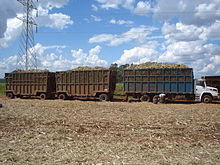
Sugarcane mechanical harvest in
Jaboticabal, São Paulo, Brazil
Mechanical harvesting uses a combine, or chopper harvester. The Austoft 7000 series was the original modern harvester design that has now been copied by other companies including Cameco/ John Deere. The machine cuts the cane at the base of the stalk, strips the leaves, and deposits the cane into a transporter, while blowing the thrash back onto the field. Such machines can harvest 100 long tons (100 t) each hour, but machine-harvested cane must be rapidly processed. Once cut, sugarcane begins to lose its sugar content, and damage to the cane during mechanical harvesting accelerates this decline.

Pests

Sugarcane exhibit at Louisiana State
Exhibit Museum
 in Shreveport shows
importance of  the crop to south 
Louisiana
from earliest times
The cane grub can substantially reduce crop yield by eating roots; it can be controlled with Confidor or Lorsban. Other important pests are the larvae of some butterfly/moth species, including the turnip moth, the sugarcane borer (Diatraea saccharalis), the Mexican rice borer (Eoreuma loftini); leaf-cutting ants, termitesspittlebugs (especially Mahanarva fimbriolata and Deois flavopicta), and the beetle Migdolus fryanus. The planthopper insect Eumetopina flavipes acts as a phytoplasma vector, which causes the sugarcane disease ramu stunt.

Pathogens

Numerous pathogens infect sugarcane, such as Sugarcane Grassy Shoot Disease caused by Phytoplasma, Whiptail disease or Sugarcane smutPokkah Boeng caused by Fusarium moniliforme, and Red Rot disease caused by Colletotrichum falcatumViral diseases affecting sugarcane include Sugarcane mosaic virusMaize streak virus, and Sugarcane Yellow Leaf Virus. See the list of sugarcane diseases.

Nitrogen fixation

Some sugarcane varieties are known to be capable of fixing atmospheric nitrogen in association with the bacterium Glucoacetobacter diazotrophicus.[5] Unlike legumes and other nitrogen fixing plants which form root nodules in the soil in association with bacteria, G. diazotrophicus lives within the intercellular spaces of the sugarcane's stem.[6][7] 

Processing
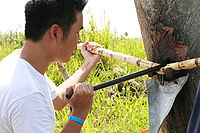
Manually extracting juice from
sugarcane
Traditionally, sugarcane processing requires two stages. Mills extract raw sugar from freshly harvested cane, and sometimes bleach it to make "mill white" sugar for local consumption. Refineries, often located nearer to consumers in North America, Europe, and Japan, then produce refined white sugar, which is 99 percent sucrose. These two stages are slowly merging. Increasing affluence in the sugar-producing tropics increased demand for refined sugar products, driving a trend toward combined milling and refining.


Milling
Small rail networks are a common method of transporting cane to a mill. Refineries test newly arrived cane for Brix and trash percentage.
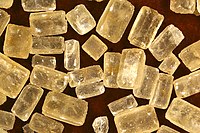
Sugar crystals
The mill washes, chops, and uses revolving knives to shred the cane. Shredded cane is repeatedly mixed with water and crushed between rollers; the collected juices contain 10–15 percent sucrose, and the remaining fibrous solids, called bagasse, are burned for fuel. Bagasse makes a sugar mill more than energy self-sufficient; surplus bagasse goes in animal feed, in paper manufacture, or to generate electricity for sale. The cane juice is next mixed with lime to adjust its pH to 7. This mixing arrests sucrose's decay into glucose and fructose, and precipitates some impurities. The mixture then sits, allowing the lime and other suspended solids to settle. The clarified juice is concentrated in a multiple-effect evaporator to make a syrup about 60 percent sucrose by weight. This syrup is further concentrated under vacuum until it becomessupersaturated, and then seeded with crystalline sugar. On cooling, more sugar crystallizes from the syrup. A centrifuge separates the sugar from the molasses. Additional crystallizations extract more sugar; the final residue is called blackstrap.
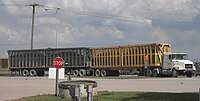
A truck hauls cane to a sugar mill
in Florida
Raw sugar is yellow to brown. Bubbling sulfur dioxide through the cane juice before evaporation bleaches many color-forming impurities into colorless ones. This sulfitation produces sugar known as "mill white", "plantation white", and "crystal sugar". Such sugar is the most commonly consumed in sugarcane-producing countries.

Refining
Santa Elisa sugarcane processing
plant in Sertãozinho, one of the largest
and oldest in Brazil
Sugar refining further purifies the raw sugar. It is first mixed with heavy syrup and then centrifuged in a process called 'affination'. Its purpose is to wash away the sugar crystals' outer coating, which is less pure than the crystal interior. The remaining sugar is then dissolved to make a syrup, about 60 percent solids by weight.
The sugar solution is clarified by the addition of phosphoric acid and calcium hydroxide, which combine to precipitate calcium phosphate. The calcium phosphate particles entrap some impurities and absorb others, and then float to the top of the tank, where they can be skimmed off. An alternative to this "phosphatation" technique is 'carbonatation,' which is similar, but uses carbon dioxide and calcium hydroxide to produce acalcium carbonate precipitate.
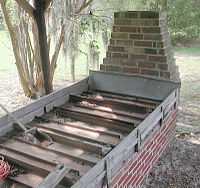
Evaporator with baffled pan and foam
dipper for making ribbon cane syrup
After filtering any remaining solids, the clarified syrup is decolorized by filtration through activated carbonBone char is traditionally used in this role.[8] Some remaining color-forming impurities adsorb to the carbon. The purified syrup is then concentrated to supersaturation and repeatedly crystallized in a vacuum, to produce white refined sugar. As in a sugar mill, the sugar crystals are separated from the molasses by centrifuging. Additional sugar is recovered by blending the remaining syrup with the washings from affination and again crystallizing to produce brown sugar. When no more sugar can be economically recovered, the final molasses still contains 20–30 percent sucrose and 15–25 percent glucose and fructose.
To produce granulated sugar, in which individual grains do not clump, sugar must be dried, first by heating in a rotary dryer, and then by blowing cool air through it for several days.

Ribbon cane syrup

A centrifuge battery, which separates
the sugar syrup from the
remaining solids
Ribbon cane is a subtropical type that was once widely grown in the southern United States, as far north as coastal North Carolina. The juice was extracted with horse or mule-powered crushers; the juice was boiled, like maple syrup, in a flat pan, and then used in the syrup form as a food sweetener. It is not currently a commercial crop, but a few growers find ready sales for their product 

Production

In India, the states of Uttar Pradesh (38.57 %), Maharashtra (17.76 %) and Karnataka (12.20 %) lead the nation in sugarcane production[9].
In the United States, sugar cane is grown commercially in FloridaHawaiiLouisiana, and Texas.[10] 

Cane ethanol
Ethanol is generally available as a by-product of sugar production. It can be used as a biofuel alternative to gasoline, and is widely used in cars in Brazil. It is a promising alternative to gasoline, and may become the primary product of sugarcane processing, rather than sugar.
A textbook on renewable energy[11] describes the energy transformation:
Worldwide sugarcane
production
At present, 75 tons of raw sugar cane are produced annually per hectare in Brazil. The cane delivered to the processing plant is called burned and cropped (b&c), and represents 77% of the mass of the raw cane. The reason for this reduction is that the stalks are separated from the leaves (which are burned and whose ashes are left in the field as fertilizer), and from the roots that remain in the ground to sprout for the next crop. Average cane production is, therefore, 58 tons of b&c per hectare per year.
Each ton of b&c yields 740 kg of juice (135 kg of sucrose and 605 kg of water) and 260 kg of moist bagasse (130 kg of dry bagasse). Since the higher heating value of sucrose is 16.5 MJ/kg, and that of the bagasse is 19.2 MJ/kg, the total heating value of a ton of b&c is 4.7 GJ of which 2.2 GJ come from the sucrose and 2.5 from the bagasse.
Per hectare per year, the biomass produced corresponds to 0.27 TJ. This is equivalent to 0.86 W per square meter. Assuming an average insolation of 225 W per square meter, the photosynthetic efficiency of sugar cane is 0.38%.
The 135 kg of sucrose found in 1 ton of b&c are transformed into 70 litres of ethanol with a combustion energy of 1.7 GJ. The practical sucrose-ethanol conversion efficiency is, therefore, 76% (compare with the theoretical 97%).
One hectare of sugar cane yields 4,000 litres of ethanol per year (without any additional energy input, because the bagasse produced exceeds the amount needed to distill the final product). This however does not include the energy used in tilling, transportation, and so on. Thus, the solar energy-to-ethanol conversion efficiency is 0.13%.
Sugarcane as food
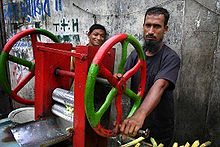
Sugarcane juice vendors in 
Dhaka
,Bangladesh

In most countries where sugarcane is cultivated, there are several foods and popular dishes derived directly from it, such as:
  • Raw sugarcane: chewed to extract the juice
  • Sugarcane juice: a combination of fresh juice, extracted by hand or small mills, with a touch of lemon and ice to make a popular drink, known variously as ganne ka rassguarab, guarapa, guarapo, papelón, aseer asabGanna sharbatmosto and caldo de cana
  • Cachaça: the most popular distilled alcoholic beverage in Brazil; a liquor made of the distillation of sugarcane
  • Jaggery: a solidified molasses, known as Gur or Gud in India, traditionally produced by evaporating juice to make a thick sludge and then cooling and molding it in buckets. Modern production partially freeze dries the juice to reduce caramelization and lighten its color. It is used as sweetener in cooking traditional entrees, sweets and desserts.
  • Panela: solid pieces of sucrose and fructose obtained from the boiling and evaporation of sugarcane juice; a food staple in Colombia and other countries in South and Central America
  • Molasses: used as a sweetener and a syrup accompanying other foods, such as cheese or cookies
  • Rapadura: a sweet flour which is one of the simplest refinings of sugarcane juice
  • Rum: a liquor made of the distillation of sugarcane commonly produced in the Caribbean. Rum is more purified then the Brasilian Cachaça.
  • Falernum: a sweet, and lightly alcoholic drink made from sugar cane juice.
  • Syrup: a traditional sweetener in soft drinks, now largely supplanted (in the US at least) by high-fructose corn syrup, which is less expensive because of subsidies.
  • Rock candy: crystallized cane juice
  • Sayur Nganten : name of Indonesian soup made of trubuk stem (Saccharum edule). 
 

References:

  1. a b "Crop production". Food and Agriculture Organization of the United Nations. Retrieved 2010-06-17.
  2. a b Watson, Andrew. Agricultural innovation in the early Islamic world. Cambridge University Press. p.26–7.
  3. a b Sharpe, Peter (1998). Sugar Cane: Past and Present. Illinois: Southern Illinois University. 
  4. ^ Eumetopina flavipes and Ramu Stunt 
  5. ^ Yamada, Y., Hoshino, K. & Ishikawa, T. (1998). "Gluconacetobacter corrig. (Gluconoacetobacter [sic]). In Validation of Publication of New Names and New Combinations Previously Effectively Published Outside the IJSB, List no. 64. Int J Syst Bacteriol 48:327–328.
  6. ^ Z. Dong et al., A Nitrogen-Fixing Endophyte of Sugarcane Stems (A New Role for the Apoplast), Plant Physiology, 1994, Vol 105, Issue 4 1139-1147
  7. ^ R. M. Boddey, S. Urquiaga, V. Reis and J. Döbereiner, Biological nitrogen fixation associated with sugar cane, Plant and Soil, Volume 137, Number 1 / November, 1991
  8. ^ Yacoubou, MS, Jeanne (2007). "Is Your Sugar Vegan? An Update on Sugar Processing Practices" (PDF). Vegetarian Journal (Baltimore, MD: The Vegetarian Resource Group) 26 (4): 16–20. Retrieved 2007-04-04.
  9. ^ "Three largest producing states of important crops". Retrieved 2008-04-06.
  10. ^ "Meagher: Sugarcane IPM". ipmworld.umn.edu. Retrieved 2008-04-11.
  11. ^ da Rosa, A, Fundamentals of Renewable Energy Processes, 2005, Elsevier, ISBN 978-0-12-088510-7, pp. 501-502
  12. Bailey, L. H. and Bailey, E. Z. 1976. Hortus Third: A Concise Dictionary of Plants Cultivated in the United States and Canada. MacMillan Publishing Company, New York


    Retrieved from: Wikipedia