Showing posts with label Wheat. Show all posts

Friday, July 22, 2011

Wheat

wheat
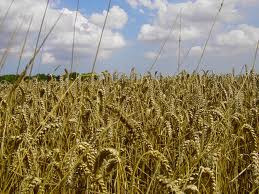
Agriculture | Wheat | Wheat is a grass, originally from the Fertile Crescent region of the Near East, but now cultivated worldwide. In 2007 world production of wheat was 607 million tons, making it the third most-produced cereal after maize (784 million tons) and rice (651 million tons). Wheat includes any agricultural cereal grass of the genus Triticum in the grass family Poaceae. Wheat is one of the top three cereal crops in terms of global production, along with maize and rice; together wheat, maize, and rice provide over half of the global requirement of calories and protein (Biodiversity International, 2007). Wheat can grow in a wide range of climates; though, it grows most favorably in temperate climates and is susceptible to disease in very hot and humid zones.

Wheat-grain
Reflecting human creativity, there are over fifty thousand cultivars of wheat currently in existence. Three important species of wheat are Triticum aestivum (common wheat), Triticum durum, and T. compactum; T. aestivum is used to make bread, T. durum is used to make pasta, and T. compactum is used to make softer cakes, crackers, cookies, and pastries.

wheat-kernel
Wheat provides other values to human beings as well. It is used for fermentation to make biofuel, beer (Palmer, 2001), and vodka (Neill, 2002). Wheat is planted to a limited extent as a forage crop for livestock and the straw can be used as fodder for livestock or as a construction material for roofing thatch (A. Smith, 1995).

Wheat
Globally, wheat is the leading source of vegetable protein in human food, having a higher protein content than either maize (corn) or rice, the other major cereals. In terms of total production tonnages used for food, it is currently second to rice as the main human food crop, and ahead of maize, after allowing for maize's more extensive use in animal feeds.

Wheat_farm
Wheat was a key factor enabling the emergence of city-based societies at the start of civilization because it was one of the first crops that could be easily cultivated on a large scale, and had the additional advantage of yielding a harvest that provides long-term storage of food. Wheat is a factor in contributing to city-states in the Fertile Crescent including the Babylonian and Assyrian empires. Wheat grain is a staple food used to make flour for leavened, flat and steamed breads, biscuits, cookies, cakes, breakfast cereal, pasta, noodles, couscous and for fermentation to make beer, other alcoholic beverages, or biofuel.

Wheat_farm
Wheat is planted to a limited extent as a forage crop for livestock, and its straw can be used as a construction material for roofing thatch. The whole grain can be milled to leave just the endosperm for white flour. The products of this are bran and germ. The whole grain is a concentrated source of vitamins, minerals, and protein, while the refined grain is mostly starch.

Wheat is a member of the grass family, Poaceae, one of the largest and most important plant families, which also includes rice and sugar cane. There are about 600 genera and perhaps ten thousand species of grasses.

Wheat-harvest
Grasses, like orchids and palms, are monocotyledons. Monocotyledons are one of two major groups of flowering plants (angiosperms), the other being dicotyledons. Monocotyledons have only one cotyledon, or embryo leaf, rather than the two found in Dicotyledons. The largest family in the monocotyledon group (and in the flowering plants) is the orchids. However, the most economically important family in this group is the grasses, which include the true grains (rice, wheat, maize, barley, etc.). Unlike dicotyledons, the true grasses are specialized for wind pollination and produce smaller flowers.

wheat-grain
Wheat is any of the cereal grasses of the Triticum genus. It has an inflorescence (group of cluster of flowers on a branch) that is a spike, an unbranched, indeterminate inflorescence with sessile flowers arranged along an axis. Each spikelet may have several florets with grains that may be hard or soft, white, red, or purple. The grain includes the embryo and a largely starch endosperm covered by layers. It is an annual plant.

Wheat-wallpaper
Wheat is one of the first cereals known to have been domesticated, and wheat's ability to self-pollinate greatly facilitated the selection of many distinct domesticated varieties. The archaeological record suggests that this first occurred in the regions known as the Fertile Crescent, and the Nile Delta. These include southeastern parts of Turkey, Lebanon, Syria, the Levant, Israel, and Egypt. Recent findings narrow the first domestication of wheat down to a small region of southeastern Turkey, and domesticated Einkorn wheat at Nevalı Çori—40 miles (64 km) northwest of Gobekli Tepe in Turkey—has been dated to 9,000 B.C. However evidence for the exploitation of wild barley has been dated to 23,000 B.C. and some say this is also true of pre-domesticated wheat. - AGRICULTURE

Wheat

Tags: wheat etf, wheat etf symbol, wheat futures trading, wheat options, wheat trading, wheat futures chart, wheat futures graph, uk wheat futures, wheat futures market, wheat futures uk, milling wheat futures, wheat futures, whole wheat popcorn, wheat storage containers, london wheat futures, wheat future, cbot wheat futures, wheat futures cbot, wheat trade, wheat commodity, whole wheat cereal, whole wheat cereals

Sunday, July 3, 2011

Russia continues to export wheat | agriculture commodities news july 3

agriculture_commodities_russia_wheat
Russia continues to export wheat | agriculture commodities news july 3 | agriculture commodities | Russia, one of the world's largest wheat exporter, to stop exports to safe domestic supplies.

Russian wheat exports have resumed after a one year suspended due to severe drought and catastrophic fires that destroyed a third of the country's harvest.

Russia, which had become the third largest wheat exporter in the world, stopping exports to secure supply for domestic consumption.

However, this year's crop is estimated to be better than projected, and based on the rainfall in May and June, the weather experts predicted last year's drought will not happen again this year.

Some Russian officials now estimate, Russia will export up to 15 million tonnes of wheat in 2011. They say they are monitoring carefully the conditions in the country while the country's exports increased.

Russian wheat prices have declined in recent weeks, officials said if prices began to rise in the country, they have a 6 million ton grain reserve to stabilize prices.

It is not clear how much until the Russians resumed exports would affect the international grain market. [ agriculture commodities ]

Tuesday, June 7, 2011

iraqi wheat news june 7 2011, iraq agriculture

iraqi wheat news june 7 2011, iraq agriculture - Over 250,000 tons of wheat marketed in Wassit: WASSIT / Aswat al-Iraq: Over 250,000 tons of wheat have been marketed by peasants and farmers of the agricultural crop for 2010-2011, the Director of Wassit’s Branch of the stated-owned General Company for Grain Trading has stated on Tuesday.

“The stores of the General Company for Grain Trading in Kut and Suwaira towns have received 253,000 tons of grain, within the winter season of 2010-2011, whilst an agreement had been reached for marketing of crops of the northern parts of Wassit Province to Baghdad’s Rusafa stores,” Engineer Malik Khalaf told Aswat al-Iraq news agency.

Iraq’s Trade Ministry recently announced that southern Iraq’s Wassit Province leads among the country’s provinces in growing and marketing wheat and barley for the current season.

Related posts:

Sunday, October 10, 2010

Wheat Flour

More wheat flour is produced than any other flour. Wheat varieties are called "clean," "white," or "brown" if they have high gluten content, and they are called "soft" or "weak" flour if gluten content is low. Hard flour, or bread flour, is high in gluten, with 12% to 14% gluten content, and has elastic toughness that holds its shape well once baked. Soft flour is comparatively low in gluten and so results in a finer or crumbly texture. Soft flour is usually divided into cake flour, which is the lowest in gluten, and pastry flour, which has slightly more gluten than cake flour. 

In terms of the parts of the grain (the grass fruit) used in flour—the endosperm or protein/starchy part, the germ or protein/vitamin-rich part, and the bran or fibre part—there are three general types of flour. White flour is made from the endosperm only. Whole grain or wholemeal flour is made from the entire grain, including bran, endosperm, and germ. A germ flour is made from the endosperm and germ, excluding the bran. 

Wheat flour types

  • All-purpose or plain flour is a blended wheat flourbread flour, ranging between 9% and 12%. Depending on brand or the region where it is purchased it may be composed of all hard or soft wheats, but is usually a blend of the two, and can range from low protein content to moderately high. It is marketed as an inexpensive alternative to bakers' flours which is acceptable for most household baking needs. with a protein content lower than
  • Bleached flour is a white flour treated with flour bleaching agents to whiten it (freshly milled flour is yellowish) and to give it more gluten-producing potential. Oxidizing agents are usually employed, most commonly organic peroxides like acetone peroxide or benzoyl peroxide, nitrogen dioxide, or chlorine. A similar effect can be achieved by letting the flour oxidize with oxygen in the air ("natural aging") for approximately 10 days; however, this process is more expensive due to the time required.
  • Bread flour is always made from hard wheat, usually hard spring wheat. It has a very high protein content, between 10% and 13%, making it excellent for yeast bread baking. It can be white or whole wheat or in between.
  • Bromated flour has a maturing agent added. The agent's role is to help with developing gluten, a role similar to the flour bleaching agents. Bromate is usually used. Other choices are phosphates, ascorbic acid, and malted barley. Bromated flour has been banned in much of the world, as bromate is classified as possibly carcinogenic in humans (Group 2B) by the International Agency for Research on Cancer (IARC), but remains available in the United States.
  • Cake flour is a finely milled white flour made from soft wheat. It has very low protein content, between 8% and 10%, making it suitable for soft- textured cakes and cookies. The higher protein content of other flours would make the cakes tough. Highly sifted cake flours may require different volume amounts in recipes than all-purpose flour. Using the scoop and level method, well-sifted flour usually produces 125g per cup. However, most American recipes are written with 140 grams of flour per cup, so weighing and experimentation can be helpful in baking unfamiliar recipes. Small weight differences can greatly affect the texture. Related to cake flour are masa harina (from maize), maida flour (from wheat or tapioca), and pure starches.
  • Graham flour is a special type of whole-wheat flour. The endosperm is finely ground, as in white flour, while the bran and germ are coarsely ground. Graham flour is uncommon outside of the USA and Europe. It is the basis of true graham crackers. Many graham crackers on the market are actually imitation grahams because they do not contain graham flour or even whole-wheat flour.
  • Instant flour is pregelatinized (precooked) for easier incorporation in gravies and sauces.
  • Pastry flour or cookie flour or cracker flour has slightly higher protein content than cake flour but lower than all-purpose flour. Its protein content ranges between 9% and 10%. It is available as a white flour, a whole-wheat flour, or a white flour with the germ retained but not the bran. It is suitable for pie pastry and tarts, some cookies, muffins, biscuits and other quick breads. Flour is shaken through a sieve to reduce the amount of lumps for cooking pastry.
  • Self-rising or self-raising flour is white flour that is sold premixed with chemical leavening agents. It was invented by Henry Jones. Self-rising flour is typically composed of the following ratio:
  • 1 cup (100 g) flour
  • 1 and 1/2 teaspoon (3 g) baking powder
  • a pinch to ½ teaspoon (1 g or less) salt
  • Sharp flour is produced in Fiji and primarily used in Indian cuisine.
  • Spelt flour is a flour produced from the type of wheat called spelt. It is less commonly used in modern cooking than other wheat varieties. It is still used for speciality baking.
  • Tang flour or wheat starch is a type of wheat flour used primarily in Chinese cooking for making the outer layer of dumplings and buns. It is also used in Vietnamese cuisine, where it is called bột lọc trong. 

Retrieved from: Wikipedia

About Wheat (2)

PAGE 1 OF 2 : PREVIOUS PAGE 

Commercial Use

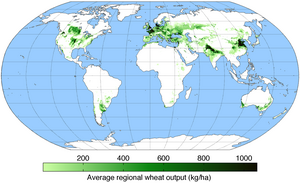
Wheat output in 
Harvested wheat grain that enters trade is classified according to grain properties for the purposes of the commodities market. Wheat buyers use these to decide which wheat to buy, as each class has special uses, and producers use them to decide which classes of wheat will be most profitable to cultivate.
Wheat is widely cultivated as a cash crop because it produces a good yield per unit area, grows well in a temperate climate even with a moderately short growing season, and yields a versatile, high-quality flour that is widely used in baking. Most breads are made with wheat flour, including many breads named for the other grains they contain like most rye and oatbreads. The popularity of foods made from wheat flour creates a large demand for the grain, even in economies with significant foodsurpluses.
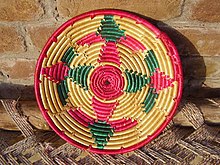
Utensil made of dry wheat branches for
loaves of br
In recent years, low international wheat prices have often encouraged farmers in the USA to change to more profitable crops. In 1998, the price at harvest was $2.68 per bushel. A USDA report[42] revealed that in 1998, average operating costs were $1.43 per bushel and total costs were $3.97 per bushel. In that study, farm wheat yields averaged 41.7 bushels per acre (2.2435 metric ton / hectare), and typical total wheat production value was $31,900 per farm, with total farm production value (including other crops) of $173,681 per farm, plus $17,402 in government payments. There were significant profitability differences between low- and high-cost farms, mainly due to crop yield differences, location, and farm size.

In 2007 there was a dramatic rise in the price of wheat due to freezes and flooding in the northern hemisphere and a drought in Australia. Wheat futures in September, 2007 for December and March delivery had risen above $9.00 a bushel, prices never seen before.[43] There were complaints in Italy about the high price of pasta.[44] This followed a wider trend of escalating food prices around the globe, driven in part by climatic conditions such as drought in Australia, the diversion of arable land to other uses (such as producing government-subsidised bio-oil crops), and later by some food-producing nations placing bans or restrictions on exports in order to satisfy their own consumers.

Other drivers affecting wheat prices include the movement to bio fuels (in 2008, a third of corn crops in the US are expected to be devoted to ethanol production)[citation needed] and rising incomes in developing countries, which is causing a shift in eating patterns from predominantly rice to more meat based diets (a rise in meat production equals a rise in grain consumption—seven kilograms of grain is required to produce one kilogram of beef).[45]

Production and Consumption

Worldwide wheat production
In 2003, global per capita wheat consumption was 67 kg, with the highest per capita consumption (239 kg) found in Kyrgyzstan.[46] In 1997, global wheat consumption was 101 kg per capita, with the highest consumption (623 kg per capita) inDenmark, but most of this (81%) was for animal feed.[47] Wheat is the primary food staple in North Africa and the Middle East, and is growing in popularity in Asia. Unlike rice, wheat production is more widespread globally though China's share is almost one-sixth of the world.

In the 20th century, global wheat output expanded by about 5-fold, but until about 1955 most of this reflected increases in wheat crop area, with lesser (about 20%) increases in crop yields per unit area. After 1955 however, there was a dramatic ten-fold increase in the rate of wheat yield improvement per year, and this became the major factor allowing global wheat production to increase. Thus technological innovation and scientific crop management with synthetic nitrogen fertilizer, irrigation and wheat breeding were the main drivers of wheat output growth in the second half of the century. There were some significant decreases in wheat crop area, for instance in North America.[48]

Better seed storage and germination ability (and hence a smaller requirement to retain harvested crop for next year's seed) is another 20th century technological innovation. In Medieval England, farmers saved one-quarter of their wheat harvest as seed for the next crop, leaving only three-quarters for food and feed consumption. By 1999, the global average seed use of wheat was about 6% of output.

Several factors are currently slowing the rate of global expansion of wheat production: population growth rates are falling while wheat yields continue to rise, and the better economic profitability of other crops such as soybeans and maize, linked with investment in modern genetic technologies, has promoted shifts to other crops.

Farming System

In the Punjab, India, and North China, irrigation has been a major contributor to increased grain output. More widely over the last 40 years, a massive increase in fertilizer use together with the increased availability of semi-dwarf varieties in developing countries, has greatly increased yields per hectare. In developing countries, use of (mainly nitrogenous) fertilizer increased 25-fold in this period. However, farming systems rely on much more than fertilizer and breeding to improve productivity. A good illustration of this is Australian wheat growing in the southern winter cropping zone, where, despite low rainfall (300 mm), wheat cropping is successful even with relatively little use of nitrogenous fertilizer. This is achieved by 'rotation cropping' (traditionally called the ley system) with leguminous pastures and, in the last decade, including acanola crop in the rotations has boosted wheat yields by a further 25% [49]. In these low rainfall areas, better use of available soil-water (and better control of soil erosion) is achieved by retaining the stubble after harvesting and by minimizing tillage.[50]

Future Contracts

Wheat futures are traded on the Chicago Board of TradeKansas City Board of Trade, and Minneapolis Grain Exchange, and have delivery dates in March (H), May (K), July (N), September (U), and December (Z).[51]

Geographical Variation

There are substantial differences in wheat farming, trading, policy, sector growth, and wheat uses in different regions of the world. In the EU and Canada for instance, there is significant addition of wheat to animal feeds, but less so in the USA.

The two biggest wheat producers are China and the EU, followed currently by India, then USA. Developed countries USA, Canada, Australia, the EU and increasingly Argentina are the major exporters with developing countries being the main importers, although both India and China are close to being self-sufficient in wheat. In the rapidly developing countries of Asia, Westernization of diets associated with increasing prosperity is leading to growth in per capita demand for wheat at the expense of the other food staples.

In the past, there has been significant governmental intervention in wheat markets, such as price supports in the USA and farm payments in the EU. In the EU these subsidies have encouraged heavy use of fertilizers inputs with resulting high crop yields. In Australia and Argentina direct government subsidies are much lower.[53]

Agronomy

Crop development

Wheat at the anthesis stage (face view)
Wheat normally needs between 110 and 130 days between planting and harvest, depending upon climate, seed type, and soil conditions (winter wheat lies dormant during a winter freeze). Optimal crop management requires that the farmer have a detailed understanding of each stage of development in the growing plants. In particular, spring fertilizersherbicidesfungicidesgrowth regulators are typically applied only at specific stages of plant development. For example, it is currently recommended that the second application of nitrogen is best done when the ear (not visible at this stage) is about 1 cm in size (Z31 on Zadoks scale). Knowledge of stages is also important to identify periods of higher risk from the climate. For example, pollen formation from the mother cell, and the stages between anthesis and maturity are susceptible to high temperatures, and this adverse effect is made worse by water stress.[54] Farmers also benefit from knowing when the 'flag leaf' (last leaf) appears, as this leaf represents about 75% of photosynthesis reactions during the grain filling period, and so should be preserved from disease or insect attacks to ensure a good yield.
Several systems exist to identify crop stages, with the Feekes and Zadoks scales being the most widely used. Each scale is a standard system which describes successive stages reached by the crop during the agricultural season.

Diseases

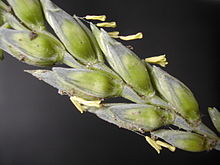
Wheat spikelet with the three
anthers sticking out
There are many wheat diseases, mainly caused by fungibacteria, and viruses.[55] Plant breeding to develop new disease-resistant varieties, and sound crop management practices are important for preventing disease. Fungicides, used to prevent the significant crop losses from fungal disease, can be a significant variable cost in wheat production. Estimates of the amount of wheat production lost owing to plant diseases vary between 10–25% in Missouri.[56] A wide range of organisms infect wheat, of which the most important are viruses and fungi.

The main wheat-disease categories are: 

Seed-borne diseases: these include seed-borne scab, seed-borne Stagonospora (previously known as Septoria), common bunt (stinking smut), and loose smut. These are managed with fungicides.
Pests

Wheat is used as a food plant by the larvae of some Lepidoptera (butterfly and moth) species including The FlameRustic Shoulder-knot,Setaceous Hebrew Character and Turnip Moth. Early in the season, birds and rodents can also cause significant damage to a crop by digging up and eating newly planted seeds or young plants. They can also damage the crop late in the season by eating the grain from the mature spike. Recent post-harvest losses in cereals amount to billions of dollars per year in the USA alone, and damage to wheat by various borers, beetles and weevils is no exception. [57] Rodents can also cause major losses during storage, and in major grain growing regions, field mice numbers can sometimes build up explosively to plague proportions because of the ready availability of food.[58] To reduce the amount of wheat lost to post-harvest pests, Agricultural Research Service scientists have developed an “insect-o-graph,” which can detect insects in wheat that are not visible to the naked eye. The device uses electrical signals to detect the insects as the wheat is being milled. The new technology is so precise that it can detect 5-10 infested seeds out of 300,000 good ones. [59] Tracking insect infestations in stored grain is critical for food safety as well as for the marketing value of the crop

References
1.   a b Belderok, Bob & Hans Mesdag & Dingena A. Donner. (2000)Bread-Making Quality of Wheat. Springer. p.3. ISBN 0-7923-6383-3.
2.   ^ "FAOSTAT". 2007. Retrieved 2009-05-05.
3.   ^ Cauvain, Stanley P. & Cauvain P. Cauvain. (2003) Bread Making. CRC Press. p. 540. ISBN 1-85573-553-9.
4.   ^ Palmer, John J. (2001) How to Brew. Defenestrative Pub Co. p. 233. ISBN 0-9710579-0-7.
5.   ^ Neill, Richard. (2002) Booze: The Drinks Bible for the 21st Century. Octopus Publishing Group - Cassell Illustrated. p. 112.ISBN 1-84188-196-1.
6.   ^ Department of Agriculture Appropriations for 1957: Hearings ...84th Congress. 2d SessionUnited States House Committee on Appropriations. 1956. p. 242.
7.   ^ Smith, Albert E. (1995) Handbook of Weed Management Systems. Marcel Dekker. p. 411. ISBN 0-8247-9547-4.
8.   a b Bridgwater, W. & Beatrice Aldrich. (1966) The Columbia-Viking Desk Encyclopedia. Columbia University. p. 1959.
9.   ^ Lev-Yadun S et al. (2000) The cradle of agriculture Science288471:1602-3 PMID 10858140
12. ^ Heun MR et al (1997) Site of Einkorn Wheat Domestication Identified by DNA Fingerprinting Science 278:1312-4 DOI: 10.1126/science.278.5341.1312
13. ^ Özkan H et al. (2002) AFLP analysis of a collection of tetraploid wheats indicates the origin of emmer and hard wheat domestication in southeast Turkey Molecular Biology and Evolution19:1797-1801 (2002) PMID 12270906
14. ^ Tanno, K Willcox, G (2006) How fast was wild wheat domesticated? Science 311 1886 DOI 10.1126/science.1124635 PMID 16574859
15. ^ Diamond J (1997) Guns, Germs and Steel, A short history of everybody for the last 13,000 years. Viking UK Random HouseISBN 0-09-930278-0
16. ^ Direct quotation: Grundas ST : Chapter: Wheat: The Crop, inEncyclopedia of Food Sciences and Nutrition p6130, 2003; Elsevier Science Ltd
17. ^ Belderok B et al. (2000) Bread-Making Quality of Wheat Springer p 3 ISBN 0-7923-6383-3
§  Cauvain SP, Cauvain P (2003) Bread Making CRC Press p 540ISBN 1-85573-553-9
§  Bergen R 'American wheat beers' In Brewing Techniques
§  FAOSTAT Agricultural statistics 2005 data values
18. a b c Hancock, James F. (2004) Plant Evolution and the Origin of Crop Species. CABI Publishing. ISBN 0-85199-685-X.
19. ^ Hoisington D et al. (1999) Plant genetic resources: What can they contribute toward increased crop productivity? Proc Natl Acad Sci USA 96:5937-43 PMID 10339521
20. ^ Basra, AS (1999) Heterosis and Hybrid Seed Production in Agronomic Crops Haworth Press pp 81-82 ISBN 1-56022-876-8
§  Condon AG et al.(1990) Genotypic variation in carbon isotope discrimination and transpiration efficiency in wheat. Leaf gas exchange and whole plant studies Australian Journal of Plant Physiology 17: 9 - 22 doi:10.1071/PP9900009
22. ^ Scientists publish key wheat genome Yahoo! News, August 27, 2010, Retrieved August 27, 2010
23. a b Bajaj, Y. P. S. (1990) Wheat. Springer. pp. 161-63. ISBN 3-540-51809-6.
24. ^ Basra, Amarjit S. (1999) Heterosis and Hybrid Seed Production in Agronomic Crops. Haworth Press. pp. 81-82. ISBN 1-56022-876-8.
25. a b Potts, D. T. (1996) Mesopotamia Civilization: The Material Foundations Cornell University Press. p. 62. ISBN 0-8014-3339-8.
26. ^ Nevo, Eviatar & A. B. Korol & A. Beiles & T. Fahima. (2002)Evolution of Wild Emmer and Wheat Improvement: Population Genetics, Genetic Resources, and Genome.... Springer. p. 8. ISBN 3-540-41750-8.
27. ^ Vaughan, J. G. & P. A. Judd. (2003) The Oxford Book of Health Foods. Oxford University Press. p. 35. ISBN 0-19-850459-4.
28. ^ Moon, David, "In the Russian Steppes: the Introduction of Russian Wheat on the Great Plains of the UNited States," Journal of Global History 3 (2008), 203-225
30. ^ International Starch Institute, TM 33-1www - ISI Technical Memorandum on Production of Wheat Starch. Retrieved August 11, 2008.
31. ^ van Heel D, West J (2006). "Recent advances in coeliac disease"Gut 55 (7): 1037–46. doi:10.1136/gut.2005.075119.PMID 16766754PMC 1856316.
33. ^ Fasano, A; Berti I, Gerarduzzi T, et al. (2003). "Prevalence of celiac disease in at-risk and not-at-risk groups in the United States: a large multicenter study"Arch Intern Med. 163 (3): 286–292. doi:10.1001/archinte.163.3.286PMID 12578508.
34. ^ Presutti, John; et al. (2007-12-27). "Celiac Disease"American Family Physician 76 (12): 196–1802.
35. ^ Hill, I. D., Horvath, K., and Fasano, A., Epidemiology of celiac disease. 1: Am J Gastroenterol. 1995 Jan;90(1):163-4
36. ^ USDA
37. ^ raw, uncoocked
38. ^ germ, crude
39. ^ white, long-grain,regular, raw, unenriched
40. ^ sweet, yellow, raw
41. ^ white, flesh and skin, raw
42. ^ Ali MB (2002) Characteristics and production costs of US wheat farms (SB-974-5 ERS, USDA.)
43. ^ "Wheat futures again hit new highs" article by Victoria Sizemore Long in The Kansas City Star September 28, 2007
44. ^ "Wheat Prices Send Italian Pasta Costs Up" Associated Pressstory by Colleen Barry, September 13, 2007 By COLLEEN BARRY – Sep 13, 2007
45. ^ "Broker picks in the soft commodities sector" inCompareShares April 2, 2008
47. ^ CIMMYT World wheat facts and trends 1998-9.
48. ^ See Chapter 1, Slafer GA, Satorre EH (1999) Wheat: Ecology and Physiology of Yield Determination Haworth Press Technology & Industrial ISBN 1560228741.
54. ^ Slafer GA, Satorre EH (1999) Wheat: Ecology and Physiology of Yield Determination Haworth Press Technology & Industrial ISBN 1560228741. pp 322-3
§  Saini HS et al. (1984) Effect of heat stress during floral development on pollen tube growth and ovary anatomy in wheat (Triticum aestivum L.) Australian Journal of Plant Physiology10:137-144 doi:10.1071/PP9830137
56. ^ "G4319 Wheat Diseases in Missouri, MU Extension". Muextension.missouri.edu. Retrieved 2009-05-18.
60. ^ "ARS, Industry Cooperation Yields Device to Detect Insects in Stored Wheat". USDA Agricultural Research Service. June 24, 2010.

Retrieved From : Wikipedia 

PAGE 1 OF 2 : PREVIOUS PAGE