Showing posts with label Corn. Show all posts

Tuesday, June 21, 2011

Homemade Corn Grains Grinding Machine

Homemade Corn Grains Grinding Machine - Corn that is hard, when processed with this machine will be quickly destroyed, and the degree of softness can be adjusted with the screen mounted.

Users: Agro-industry users, poultry farmers.

Functions: For grinding dry corn grains or other cereals that used for animal feed.

Specifications:
  • Power: Small Engine 12-18 HP
  • Capacity: 400-500 kg / hr
  • Size:
    • Length: 1260 mm
    • Width: 720 mm
    • Height: 1370 mm
    • Weight: + - 240 k
  • Life Time: 5 (five) years

How to Operate the Machine:
  1. Feed the raw materials into the hollow discs foundation which surface serrated. 
  2. The feeder surface is covered by the inverted pyramid form of a grinding disc that is inserted into the hollow discs runway. 
  3. Surface of grinding disc is also serrated. 
  4. Disc grinder continuosly rotated by hand. 
  5. The rotating of grinding disc makes the material crushed and broken.

Corn, Maize: the conventions of naming

corn-maize-agriculture-commodity
Corn, Maize: the conventions of naming - The term "maize" comes from the Spanish form of Maiz, a Taino word for the original plant. This was the term used in the UK and Ireland, where he is now usually called "sweet corn", the most common type of plant known to the people there. Sweet corn is harvested earlier and eaten as a vegetable instead of a grain.

Outside the British Isles, another common term for corn is 'maize'. It was originally the term for other cereals. In North America, its meaning has been restricted since the 19th century for corn, and was reduced to "corn". Corn term now refers specifically to the colorful "corn" (corn Flint) cultivars.

When using scientific and formal, the "corn" usually used in a global context. Similarly, most of the commercial, the "corn" used frequently. In Britain, Australia and other English speaking countries, the word "corn" is often used in culinary contexts, particularly in naming products such as popcorn and corn flakes. Although it should be noted that in the United States, the term "corn" is almost unknown. "Corn" is used in agricultural and scientific references.

Sunday, June 19, 2011

Corn, one of the world's most important food crop

corn-maize-agriculture-commodities
Corn, one of the world's most important food crop - Maize or Corn (Zea mays L. ssp. from Spanish:  Maiz after Taino: mahiz), known in many English speaking countries, such as mealie / mielie or corn, is a cereal domesticated by the indigenous peoples in Central America in the prehistoric times. By main classification it's included to vegetable, but is technically a fruit.

The Olmec and the Maya, cultivated corn  in many varieties in the area of central and southern Mexico, to grind and cook them - corn - in a process called nixtamalization. Between 1700 and 1250 BC, the culture spread through much of America. Any large or dense populations in the region has developed a network based on the large trade and surplus of corn. In case of contact with Europeans in the Americas in the late 15th - early 16 th centuries, explorers and traders of maize was introduced in Europe and other countries through trade. Maize spread to the rest of the world due to its popularity and its ability to grow in different climates.

Corn is the most widespread crop in the Americas with 332 million metric tons grown annually in the United States (although 40% of the harvest - 130 million tons -. It is used for corn ethanol). Transgenic corn (GM = genetally modified) represented 85% of corn planted in the United States in 2009. While some corn varieties grow to 12 meters (39 feet) high, most commercially grown corn was raised in a standard height of 2.5 meters (8.2 feet). Sweet corn is usually shorter than field corn varieties.

Tags: corn, maize, agriculture, commodity, commodities, agriculture commodity, agriculture commodities, food, foods, crop, crops, food crop, staple food, whole food, food stamps, corn mazes, food science, corn maze, transgenic, transgenic food, genetically modified, genetically modified food

Wednesday, May 4, 2011

How to Turn Corn Tortilla into Homemade Tortilla Chips

Homemade-Tortilla-Chips
Restaurant and store-bought tortilla chips can not compare to fresh and more crunchy homemade tortilla chips. Tortilla chips are fast and easy to produce and you can use them in any recipe calls for tortilla chips. Fry or bake up some and enjoy it plain, with salsa and dips, or in a batch of nachos.

What you need:
  • 1 quart. oil for frying
  • 1 (12 ounce) package corn tortillas
  • Salt to taste
  • a large pot
  • skimmer
  • Cutting Board
  • Knife
  • Bowl

Directions:
  1. Cut tortillas into wedges or strips.
  2. Line a bowl with paper towels (to absorb excess oil).
  3. Heat oil in large saucepan to about 375 degrees.
  4. Fall of the tortillas in oil in small quantities. Brown.
  5. Remove chips from the oil in a slotted spoon. Transfer to a bowl to cool.
  6. Sprinkle with salt while still hot.
  7. Repeat steps 4-6 with the remaining tortillas

Monday, May 2, 2011

How to Turn Corn into Biofuel

obama-corn-biofuels-ethanol-biodiesel
If gas prices are too high for you and your car can run on ethanol E-85, you can try making your own biodiesel from corn. The process is complex and there are some security measures you need to know, but almost anyone can make biofuel for your car (or other) right in your own backyard.

Things you need:
  • Corn
  • Enzyme liquefaction
  • Water
  • Authorization distillation fuel
  • Distiller
  • Screening mill (7/64th inch)
  • Disk Mill

Directions:
  1. Grind corn, similar to the consistency of corn.
  2. Add water (not corn, not yet) to cook in peace and bring the temperature up to 170 degrees (F). You'll need about 30 gallons of water per bushel of corn.
  3. Slowly add the corn meal, ground water, but be careful not to cause "lumps".
  4. Add three measuring spoons (supplied with enzyme) to a value of the enzyme alpha-amylase in the mixture.
  5. Stir the solution at this temperature for 15 minutes.
  6. Increasing the temperature of the mixture to a boil and simmer for 30 minutes drive.
  7. Reduce heat after 30 minutes at 170 degrees.
  8. Add three tablespoons of enzyme and stir for 30 minutes.
  9. Reduce temperature to 85 degrees (F) and adding six more tablespoons of the enzyme.
  10. Store at 85 degrees for 48-72 hours to complete the fermentation.
  11. After fermentation is complete, you must use the mill screening to filter the mixture. What will you be left to the is E85.

Friday, October 15, 2010

About Starch

Starch or amylum is a carbohydrate consisting of a large number of glucose units joined together by glycosidic bonds. This polysaccharideis produced by all green plants as an energy store. It is the most important carbohydrate in the human diet and is contained in such staple foods as potatoes, wheat, maize (corn), rice, and cassava.

Pure starch is a white, tasteless and odorless powder that is insoluble in cold water or alcohol. It consists of two types of molecules: the linear and helical amylose and the branched amylopectin. Depending on the plant, starch generally contains 20 to 25% amylose and 75 to 80% amylopectin. Glycogen, the glucose store of animals, is a more branched version of amylopectin.

Starch is processed to produce many of the sugars in processed foods. When dissolved in warm water, it can be used as a thickening, stiffening or gluing agent, giving wheatpaste.

Name

The word "starch" is derived from Middle English sterchen, meaning to stiffen. "Amylum" is Latin for starch, from the Greek "amulon" which means "not ground at a mill". The root amyl is used in biochemistry for several compounds related to starch.

History

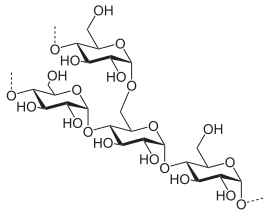
Structure of the amylose molecule
Wheat starch paste was used by Egyptians to stiffen cloth and during weaving linen and possibly to glue papyrus. Romans used it also in cosmetic creams, to powder the hair and to thicken sauces. Persians and Indians used it to make dishes similar to gothumai wheat halva. In China, with the invention of paper, rice starch was used as a surface treatment of the paper.
In photosynthesis, plants use light energy to produce glucose from carbon dioxide. The glucose is stored mainly in the form of starch granules, in plastids such as chloroplasts and especially amyloplasts. Toward the end of the growing season, starch accumulates in twigs of trees near the buds. Fruit, seeds, rhizomes, and tubers store starch to prepare for the next growing season.

Structure of the amylopectin molecule
Glucose is soluble in water, hydrophilic, binds much water and then takes up much space; glucose in the form of starch, on the other hand, is not soluble and can be stored much more compactly.

Glucose molecules are bound in starch by the easily hydrolyzed alpha bonds. The same type of bond can also be seen in the animal reserve polysaccharide glycogen. This is in contrast to many structural polysaccharides such as chitin, cellulose and peptidoglycan, which are bound by beta-bonds and are much more resistant to hydrolysis.

Biosynthesis

Granules of wheat starch, stained
with iodine, photographed through
a light microscope.
Plants produce starch by first converting glucose 1-phosphate to ADP-glucose using the enzyme glucose-1-phosphate adenylyltransferase. This step requires energy in the form of ATP. The enzyme starch synthase then adds the ADP-glucose via a 1,4-alpha glycosidic bond to a growing chain of glucose residues, liberating ADP and creating amylose. Starch branching enzymeintroduces 1,6-alpha glycosidic bonds between these chains, creating the branched amylopectin. The starch debranching enzyme isoamylaseremoves some of these branches. Several isoforms of these enzymes exist, leading to a highly complex synthesis process. While amylose was traditionally thought to be completely unbranched, it is now known that some of its molecules contain a few branch points.
Glycogen and amylopectin have the same structure, but the former has about one branch point per ten 1,4-alpha bonds, compared to about one branch point per thirty 1,4-alpha bonds in amylopectin. Another difference is that glycogen is synthesised from UDP-glucose while starch is synthesised from ADP-glucose.

Properties

Structure

Starch molecules arrange themselves in the plant in semi-crystalline granules. Each plant species has a unique starch granular size: rice starch is relatively small (about 2μm) while potato starches have larger granules (up to 100μm). Although in absolute mass only about one quarter of the starch granules in plants consist of amylose, there are about 150 times more amylose molecules than amylopectin molecules. Amylose is a much smaller molecule than amylopectin.

Starch becomes soluble in water when heated. The granules swell and burst, the semi-crystalline structure is lost and the smaller amylose molecules start leaching out of the granule, forming a network that holds water and increasing the mixture's viscosity. This process is calledstarch gelatinization. During cooking the starch becomes a paste and increases further in viscosity. During cooling or prolonged storage of the paste, the semi-crystalline structure partially recovers and the starch paste thickens, expelling water. This is mainly caused by the retrogradation of the amylose. This process is responsible for the hardening of bread orstaling, and for the water layer on top of a starch gel (syneresis).

Some cultivated plant varieties have pure amylopectin starch without amylose, known as waxy starches. The most used is waxy maize, others are glutinous rice and waxy potato starch. Waxy starches have less retrogradation, resulting in a more stable paste. High amylose starch, amylomaize, is cultivated for the use of its gel strength.

Hydrolysis

The enzymes that break down or hydrolyze starch into the constituent sugars are known as amylases.

Alpha-amylases are found in plants and in animals. Human saliva is rich in amylase, and the pancreas also secretes the enzyme. Individuals from populations with a high-starch diet tend to have more amylase genes than those with low-starch diets; chimpanzees have very few amylase genes. It is possible that turning to a high-starch diet was a significant event in human evolution.

Beta-amylase cuts starch into maltose units. This process is important in the digestion of starch and is also used in brewing, where the amylase from the skin of the seed grains is responsible for converting starch to maltose (Malting, Mashing).

Dextrinization

If starch is subjected to dry heat, it breaks down to form pyrodextrins, in a process known as dextrinization. Pyrodextrins are brown in color. This process is partially responsible for the browning of toasted bread.

Chemical Tests

Starch, 800x magnified, under polarized light
Iodine solution is used to test for starch; a dark blue color indicates the presence of starch. The details of this reaction are not yet fully known, but it is thought that the iodine (I3-and I5-ions) fit inside the coils of amylose, the charge transfers between the iodine and the starch, and the energy level spacings in the resulting complex correspond to the absorption spectrum in the visible light region. The strength of the resulting blue color depends on the amount of amylose present. Waxy starches with little or no amylose present will color red.

Starch indicator solution consisting of water, starch and iodine is often used in redox titrations: in the presence of an oxidizing agent the solution turns blue, in the presence of reducing agent the blue color disappears because triiodide (I3-) ions break up into three iodide ions, disassembling the starch-iodine complex. A 0.3% w/w solution is the standard concentration for a starch indicator. It is made by adding 3 grams of soluble starch to 1 litre of heated water; the solution is cooled before use (starch-iodine complex becomes unstable at temperatures above 35 °C).

Microscopy of starch granules - Each species of plant has a unique shape of starch granules in granular size, shape and crystallisation pattern. Under the microscope, starch grains stained with iodine illuminated from behind with polarized light show a distinctive Maltese cross effect (also known as extinction cross and birefringence).

Starch as Food

Starch is the most important carbohydrate in the human diet and is contained in many staple foods. The major sources of starch intake worldwide are rice, wheat, maize (corn), potatoes and cassava. Widely used prepared foods containing starch are bread, pancakes, cereals, noodles, pasta, porridge and tortilla.

Depending on the local climate other starch sources are used for food, suchas acorn,arrowroot, arracacha, banana, barley, breadfruit, buckwheat, canna, colacasia, katakuri, kudzu, malanga, millet, oat, oca, polynesian arrowroot, sago, sorghum, sweet potato, rye, taro, water chestnut and yams. Chestnuts and edible beans, such as favas, lentils, mung bean and peas, are also rich instarch.

Digestive enzymes have problems digesting crystalline structures. Raw starch will digest poorly in the duodenum and small intestine, while bacterial degradation will take place mainly in the colon. Resistant starch is starch that escapes digestion in the small intestine of healthy individuals. In order to increase the digestibility, starch is cooked. Hence, before humans started using fire, eating grains was not a very useful way to get energy.

Starch Industry

The starch industry extracts and refines starches from seeds, roots and tubers, by wet grinding, washing, sieving and drying. Today, the main commercial refined starches arecornstarch, tapioca, wheat and potato starch. To a lesser extent, sources include rice, sweet potato, sago and mung bean. Historically, Florida arrowroot was also commercialized. Starch is still extracted from more than 50 types of plants.

Untreated starch requires heat to thicken or gelatinize. When a starch is pre-cooked, it can then be used to thicken instantly in cold water. This is referred to as a pregelatinized starch.

Starch Sugars

Starch can be hydrolyzed into simpler carbohydrates by acids, various enzymes, or a combination of the two. The resulting fragments are known as dextrins. The extent of conversion is typically quantified by dextrose equivalent (DE), which is roughly the fraction of the glycosidic bonds in starch that have been broken.

These starch sugars are by far the most common starch based food ingredient and are used as sweetener in many drinks and foods. They include:
  • Maltodextrin, a lightly hydrolyzed (DE 10-20) starch product used as a bland-tasting filler and thickener.
  • Various glucose syrup / corn syrups (DE 30-70), viscous solutions used as sweeteners and thickeners in many kinds of processed foods.
  • Dextrose (DE 100), commercial glucose, prepared by the complete hydrolysis of starch.
  • High fructose syrup, made by treating dextrose solutions with the enzyme glucose isomerase, until a substantial fraction of the glucose has been converted to fructose. In the United States, high fructose corn syrup is the principal sweetener used in sweetened beverages because fructose has better handling characteristics, such as microbiological stability, and more consistent sweetness/flavor. High fructose corn syrup has the same sweetness as sugar.
  • Sugar alcohols, such as maltitol, erythritol, sorbitol, mannitol and hydrogenated starch hydrolysate, are sweeteners made by reducing sugars.

Modified Starches

A modified food starch is a starch that has been chemically modified to allow the starch to function properly under conditions frequently encountered during processing or storage, such as high heat, high shear, low pH, freeze/thaw and cooling.

The modified starches are E coded according to the International Numbering System for Food Additives (INS):
  • 1401 Acid-treated starch
  • 1402 Alkaline-treated starch
  • 1403 Bleached starch
  • 1404 Oxidized starch
  • 1405 Starches, enzyme-treated
  • 1410 Monostarch phosphate
  • 1412 Distarch phosphate
  • 1413 Phosphated distarch phosphate
  • 1414 Acetylated distarch phosphate
  • 1420 Starch acetate
  • 1422 Acetylated distarch adipate
  • 1440 Hydroxypropyl starch
  • 1442 Hydroxypropyl distarch phosphate
  • 1443 Hydroxypropyl distarch glycerol
  • 1450 Starch sodium octenyl succinate
  • 1451 Acetylated oxidized starch

INS 1401, 1402, 1403 and 1405 are in the EU food ingredients without an E-number. Typical modified starches for technical applications are cationic starches, hydroxyethyl starch and carboxymethylated starches.

Use as Food Additive 

As an additive for food processing, food starches are typically used as thickeners and stabilizers in foods such as puddings, custards, soups, sauces, gravies, pie fillings, and salad dressings, and to make noodles and pastas.

Gummed sweets such as jelly beans and wine gums are not manufactured using a mold in the conventional sense. A tray is filled with native starch and leveled. A positive mold is then pressed into the starch leaving an impression of 1000 or so jelly beans. The jelly mix is then poured into the impressions and put into a stove to set. This method greatly reduces the number of molds that must be manufactured.
In the pharmaceutical industry, starch is also used as an excipient, as tablet disintegrant or as binder.

Industrial Application 

Papermaking is the largest non-food application for starches globally, consuming millions of metric tons annually. In a typical sheet of copy paper for instance, the starch content may be as high as 8%. Both chemically modified and unmodified starches are used in papermaking. In the wet part of the papermaking process, generally called the “wet-end”, the starches used are cationic and have a positive charge bound to the starch polymer. These starch derivatives associate with the anionic or negatively charged paper fibers /cellulose and inorganic fillers. Cationic starches together with other retention and internal sizing agent help to give the necessary strength properties to the paper web to be formed in the papermaking process (wet strength), and to provide strength to the final paper sheet (dry strength).

Starch adhesive.
In the dry end of the papermaking process the paper web is rewetted with a starch based solution. The process is called surface sizing. Starches used have been chemically, or enzymatically depolymerized at the paper mill or by the starch industry (oxidized starch). The size - starch solutions are applied to the paper web by means of various mechanical presses (size press). Together with surface sizing agent the surface starches impart additional strength to the paper web and additionally provide water hold out or “size” for superior printing properties. Starch is also used in paper coating as one of the binders for the coating formulation a mixture of pigments, binders and thickeners. Coated paper has improved smoothness, hardness, whiteness and gloss and thus improves printing characteristics.

Corrugated board adhesives are the next largest application of non-food starches globally. Starch glues are mostly based on unmodified native starches, plus some additive such asborax and caustic soda. Part of the starch is gelatinized to carry the slurry of uncooked starches and prevent sedimentation. This opaque glue is called a SteinHall adhesive. The glue is applied on tips of the fluting. The fluted paper is pressed to paper called liner. This is then dried under high heat, which causes the rest of the uncooked starch in glue to swell/gelatinize. This gelatinizing makes the glue a fast and strong adhesive for corrugated board production.

Another large non-food starch application is in the construction industry, where starch is used in the gypsum wall board manufacturing process. Chemically modified or unmodified starches are added to the stucco containing primarily gypsum. Top and bottom heavyweight sheets of paper are applied to the formulation, and the process is allowed to heat and cure to form the eventual rigid wall board. The starches act as a glue for the cured gypsum rock with the paper covering, and also provide rigidity to the board.

Starch is used in the manufacture of various adhesives or glues for book-binding, wallpaper adhesives, paper sack production, tube winding, gummed paper, envelop adhesives, school glues and bottle labeling.

Starch derivatives, such as yellow dextrins, can be modified by addition of some chemicals to form a hard glue for paper work; some of those forms use borax or soda ash, which are mixed with the starch solution at 50-70 °C to create a very good adhesive. Sodium silicate can be added to reinforce these formulae.

Clothing starch or laundry starch is a liquid that is prepared by mixing a vegetable starch in water (earlier preparations also had to be boiled), and is used in the laundering of clothes. Starch was widely used in Europe in the 16th and 17th centuries to stiffen the wide collars and ruffs of fine linen which surrounded the necks of the well-to-do. During the 19th century and early 20th century, it was stylish to stiffen the collars and sleeves of men's shirts and the ruffles of girls' petticoats by applying starch to them as the clean clothes were being ironed. Aside from the smooth, crisp edges it gave to clothing, it served practical purposes as well. Dirt and sweat from a person's neck and wrists would stick to the starch rather than to the fibers of the clothing, and would easily wash away along with the starch.

After each laundering, the starch would be reapplied. Today, the product is sold in aerosol cans for home use.


Starch is also used to make some packing peanuts, and some drop ceiling tiles.

Textile chemicals from starch are used to reduce breaking of yarns during weaving; the warp yarns are sized, especially for cotton. Starch is also used as textile printing thickener.

In the printing industry, food grade starch is used in the manufacture of anti-set-off spray powder used to separate printed sheets of paper to avoid wet ink being set off.

Starch is used to produce various bioplastics, synthetic polymers that are biodegradable. An example is polylactic acid.

For body powder, powdered corn starch is used as a substitute for talcum powder, and similarly in other health and beauty products.

In oil exploration, starch is used to adjust the viscosity of drilling fluid, which is used to lubricate the drill head and suspend the grinding residue in petroleum extraction.

Glucose from starch can be further fermented to biofuel ethanol.

Hydrogen production can use starch as the raw material, using enzymes.


References
  1. ^ Brown, W. H.; Poon, T. (2005). Introduction to organic chemistry (3rd ed.). Wiley. ISBN0-471-44451-0. .
  2. ^ Revedin A, Aranguren B, Becattini R, Longo L, Marconi E, Lippi MM, Skakun N, Sinitsyn A, Spiridonova E, Svoboda J. (2010). "Thirty thousand-year-old evidence of plant food processing". Proc Natl Acad Sci U S A. 107: 18815–18819. doi:10.1073/pnas.1006993107. PMID 20956317.
  3. ^ Pliny the Elder, The Natural History (Pliny), Book XIII, Chapter 26, The paste used in preparation of paper
  4. ^ Smith, A M (2001). "The biosynthesis of starch granules". Biomacromolecules 2 (2): 335–41. doi:10.1021/bm000133c. PMID 11749190.
  5. ^ David R. Lineback, "Starch", in AccessScience@McGraw-Hill.
  6. ^ Stryer, Lubert; Berg, Jeremy Mark; Tymoczko, John L. (2002). "Section 11.2.2". Biochemistry (5th ed.). San Francisco: W.H. Freeman. ISBN 0-7167-3051-0. http://www.ncbi.nlm.nih.gov/books/bv.fcgi?rid=stryer.section.1517#1522.
  7. ^ a b "Diet and the evolution of human amylase gene copy number variation". Nature Genetics by Nature Publishing Group. http://www.nature.com/ng/journal/v39/n10/full/ng2123.html.
  8. ^ PZ Myers, Amylase and human evolution, December 11, 2008.
  9. ^ Anne-Charlotte Eliasson (2004). Starch in food: Structure, function and applications. Woodhead Publishing. ISBN 9780849325557.
  10. ^ http://www.elmhurst.edu/~chm/vchembook/549sweet.html
  11. ^ http://www.foodproductdesign.com/articles/2008/12/hfcs-how-sweet-it-is.aspx
  12. ^ Modified Starches. CODEX ALIMENTARIUS published in FNP 52 Add 9 (2001)
  13. ^ "Starch based glue". - ICI. http://www.nationalstarch.com/NationalStarch/About+Us/Our+Businesses.
  14. ^ "Spray Powder". Russell-Webb. Archived from the original on 2007-08-09. http://web.archive.org/web/20070809214841/http://www.russell-webb.com/anti_set_off_powder/soluble_anti-set-off-powder.html. Retrieved 2007-07-05.
  15. ^ Zhang YH, Evans BR, Mielenz JR, Hopkins RC, Adams MW (2007). "High-yield hydrogen production from starch and water by a synthetic enzymatic pathway". PLoS ONE 2 (5): e456. doi:10.1371/journal.pone.0000456. PMID 17520015. PMC 1866174. http://www.plosone.org/article/fetchArticle.action?articleURI=info:doi/10.1371/journal.pone.0000456.

 Retrieved from: Wikipedia

Thursday, October 14, 2010

The US Project of First Corn-powered Train

The US Project of First Corn-powered Train - First corn-powered train closer to reality the Corn Marketing Program of Michigan (CMPM) strives to create partnerships with businesses and other organizations for the improvement of the corn Michigan. CMPM AHL-TECH has been working with to develop the world's first ethanol-electric hybrid locomotive economy. "AHL-Tech has developed an ethanol hybrid locomotive for the growing demand for ethanol in the U.S. market, and the railroad industry to replace the old diesel-electric locomotive fleet," said Tom Mackin, president and CEO of AHL-TECH. The current diesel-electric locomotives that make up the backbone of the freight fleet ranging from 1000 4400 horsepower (hp). Diesel engines are connected to large generators that drive electric motors that are directly connected to the axles of the locomotive.

Just as the diesel-electric locomotives, ethanol engine powers the generator is connected to the axles of the locomotive. Unlike diesel-electric hybrid ethanol AHL-Tech is also a component of the battery. Instead of a direct correlation between the speed of the motor and the power transmitted to the generator, AHL-Tech offers the possibility to store electricity when the generator produces more power than ever before. This gives the driver the ability to power the motor shafts by using or by using the energy stored in the main battery. It also allows regenerative braking - capturing the energy lost when the locomotive stops.

AHL-TECH graduate of the overall design of 4000 hp, six-axle locomotives (3000 hp six generators, ethanol, hybrid batteries more than 1000 hp) in 2008. This high-powered locomotive is a brand new AHL-TECH, the cab and the body, which meets all the shock resistance of 2,009 U.S. locomotives. In addition, high-power locomotives, AHL-Tech is also designed retrofit package low power (1000-1500 hp) Switcher locomotives using the same components as the higher horsepower locomotives. "We are very excited about the opportunities to retrofit hundreds of very old switcher locomotives in the United States with a clean cloth, the 21 st century technology for ethanol," said Mack.

Since the completion of the design of low power and high in 2008, the AHL-TECH has continued its development efforts, training and sales for its revolutionary line of ethanol-electric hybrid locomotives. In 2009, AHL-TECH able to complete two important steps in the development of its hybrid locomotive, large studies of the battery and energy storage system EMCap.

The study was conducted by the University of Toledo and control EMCap Compressor Company Chelsea, Michigan The results of this study was a final bill of materials, the model of the duration of the energy and cost model for EMCap complete system.

The second study focused on the battery, including the production of the battery tray of the first prototype of the Crown of the battery in Fremont, Ohio, with five in-depth test cycles of the hill. "The test showed that our use of expensive lead-acid batteries based on solid design and modeling," says Mack. "Batteries can certainly provide the necessary power and economy are where we need them to be."

While the second study shows the possibility of battery system AHL-TECH has the recent economic downturn has helped to illustrate the marketability of the design of ethanol. The recent volatility of oil markets, with sudden peaks above 140 dollars a barrel and sharp drop below 40 dollars a barrel, showed people how dangerous our dependence on foreign oil can be. While these markets have somewhat stabilized in recent months, it can not compete with corn and ethanol prices, it has been remarkably stable in comparison. This stability has helped to allay the fears of people who thought there would not be enough ethanol available, or that prices would get out of hand. With fears of political calm and stable wholesale prices, ethanol has proven to be very attractive to buyers of fuel, even at the cost of diesel.

Mack recognizes still face several challenges. "I think the main problem is the teaching. When talking of the AHL-TECH locomotives, the first thing people ask how" small "calorific BTU as ethanol can not compete with" high "Btu of fuel than diesel but missing the point, four factors, which are actually involved, the right to produce ethanol fuel option. BTU is a factor, but so are fuel costs per gallon, engine efficiency and, ultimately, the cost of engine emission control. So even if the lower BTU ethanol is a fuel oil, was significantly lower than the price of a gallon for, "said Mack. Based on data from the University of Nebraska-Lincoln, AHL-TECH has created a new model for emissions from ethanol, the locomotive engine, which indicates that there may be ten times cleaner than the emissions of oxides of nitrogen required by the Environmental Protection Agency Tier 4 locomotive emissions guidelines and can virtually eliminate particulate matter.

"No need to add costly filters or catalytic reduction systems to do so. This translates into lower costs for engines and low maintenance cost. It's a win-win-win" Mack said

As work continues on the AHL-TECH project CMPM happy with what the future holds. "With the ethanol is already used in more than 80 percent of the supply of the nation's automotive fuel, we feel the engines running on ethanol are a very promising market for ethanol," said Clark Gerstacker , CMPM President, National Corn Growers Association Corn Board, and corn producer in Midland. "Because corn is the main raw material for ethanol production in the United States could AHL-TECH is ethanol hybrid locomotives open the door to a new untapped market for corn Michigan. CMPM are delighted to be part of this innovative project. "

More corn (fuel) allowed in gasoline tanks

msnbc.com
msnbc.com staff and news service reports
updated 10/13/2010 1:27:27 PM ET 2010-10-13T17:27:27

Up to 15 percent ethanol now OK; carmakers, gas stations opposed

WASHINGTON — Angering environmentalists but pleasing corn farmers, the Environmental Protection Agency on Wednesday approved blending higher concentrations of ethanol into gasoline for newer vehicles.

Mixtures with up to 15 percent of the corn-based fuel at the pump are now allowed, up from the previous maximum of 10 percent for vehicles manufactured since 2007.

"Thorough testing has now shown that E15 does not harm emissions control equipment in newer cars and light trucks," EPA chief Lisa Jackson said in a statement. "Wherever sound science and the law support steps to allow more home-grown fuels in America’s vehicles, this administration takes those steps."

Sunday, October 10, 2010

About Tortilla

Mexican-style tortillas being made in
Old Town
San Diego
Tortilla (Peninsular Spanish: [torˈtiʎa]; Mexican Spanish [torˈtiʝa]English: /tɔrˈtiː.ə/) means "little cake" in Spanish, and refers to several different foods eaten in various Spanishspeaking countries and parts of the United States. In MexicoCentral America and theUnited States, "tortilla" refers to a flatbread made from corn or wheat originally made byMesoamerican peoples. In SpainSouth AmericaCuba, and Puerto Rico, "tortilla" refers to an omelette, with variations that can include vegetables such as onions and potatoes. 

Tortillas have been used for many centuries in Mexico, where they are consumed year round. More recently other countries have begun producing them to serve the expatriate Mexican market and the growing demand for Mexican food, particularly in North AmericaEurope andEastern Asia. Mexican tortillas are most commonly prepared with meat to make dishes such as tacosburritos, and enchiladas, however, there are many alternate versions without meat. 

Different meanings of tortilla 

The Spanish word tortilla [torˈtiʎa] denotes two different classes of foods, depending on where the term is encountered. In SpainPuerto RicoCubaSouth America, a tortilla is any omelette, often a round, layered omelette (i.e., not folded over), most typically made with chopped potatoes (Tortilla de patatas) cooked in vegetable oil, mixed with beaten eggs and such seasonings as the chef desires, and cooked very slowly on the stove. It is usually served cold as an appetizer, tapas, or bar snack. The terms Spanish tortillatortilla española or tortilla de patatas all refer to a common recipe in Spain, an omelette with fried potatoes and chopped onion, often served in Spanish bars and cafés. American versions of Spanish and South American tortilla are usually cooked in vegetable shortening, commonly with bell pepper and/oronion and/or chives; and typically served warm instead of cold. 

In Panama, a tortilla is a deep fried cornmeal disk, slightly smaller than a hockey puck.

But it is the Mexican meaning of "tortilla" that may be most familiar throughout the world. The corn tortilla (tortilla de maíz), made from specially treated (nixtamalizedmaize flour, have been a staple food of the Mexican region since pre-Columbian times; these are also now commonly made from wheat flour (tortilla de harina or tortilla de trigo).

The two versions of the Mexican tortilla have different textures owing to the grains from which they originate: the maize version is somewhat thicker and heartier in texture, while the wheat version is less easily broken, due to its elevated gluten content, and therefore often larger in circumference.
Corn tortillas are commonly eaten throughout the western world as tortilla chips, and are an essential ingredient in many popular Mexican and dishes such as enchiladastostadas, and flautasTacos, while commonly made with corn tortillas in Mexico, are made with either maize or wheat tortillas in the US. (See main articles on Mexican cuisine and Tex-Mex.)

The flour tortilla is probably best known as the tortilla used to make burritos, a dish originating in northern Mexico. Wheat tortillas have also become a staple of the peoples of northwestern Mexican states (such as Sonora and Chihuahua) and many southwestern US Native American tribes.

Maize tortillas are known in the Basque region of Spain as talo and were a traditional Basque farmers' staple until the introduction of railborne wheat flour suitable for bread. There are maize tortillas in other regions of Northern Spain, such as Asturias, where they are called frixuelos, and Galicia, where they receive the name of filloas.

The South American tortilla of Argentina, Bolivia and Chile, is inspired by the Mexican food, but is a small flat cake, usually salty, made with wheat or corn flour, and cooked over embers. 

History of the tortilla
An 1836 lithograph of women making
tortillas in early 19th-century Mexico.
By Carl Nebe
l
It is impossible to give an exact date or location for the invention of the tortilla. According to Mayan legend, tortillas were invented by a peasant for his hungry king in ancient times. The first tortillas, which date back to approximately 10 000 BC, were made of native corn with dried kernel. The Aztecs used a lot of corn, both eaten straight from the cob and in recipes. They would grind the corn into cornmeal and from this make a dough called masa.[1]
Excavations in the "Valle de Tehuacán" in the state of Puebla, Mexico, have revealed the use around 3000 BC of the basic cereal, a small, wild cob, eaten by native people. According to Agustín Gaytán, chef and Mexican Cuisine historian, in a Greeley Tribune newspaper article:
"Sometime about 3000 BC, people of the Sierra Madre mountains in Mexico hybridized wild grasses to produce large, nutritious kernels we know as corn. Mexican anthropologist and maize historian Arturo Warman credits the development of corn with the rise of Mesoamerican civilizations such as the Mayans and the Aztecs, which were advanced in art, architecture, math and astronomy. The significance of corn was not lost on indigenous cultures that viewed it as a foundation of humanity. It is revered as the seed of life. According to legend, human beings were made of corn by the Gods. By the time Spaniards reached the shores of what is now Mexico in the 1400s, indigenous Mesoamericans had a sophisticated and flavorful cuisine based on native fruits, game, cultivated beans and corn and domesticated turkeys".[2]
April 22, 1519, Spaniards led by Hernán Cortés, also known as Hernando Cortez, arrived in the "New World" (what we know in modern-day as Cuba and Mexico). They discovered that the inhabitants (Aztecs, Mexicans) made flat corn bread. The native Nahuatl name for this was tlaxcalli.
In Cortés' 1520 second letter to King Charles V of Spain, he described the public markets:
"This city has many public squares, in which are situated the markets and other places for buying and selling. . . where are daily assembled more than sixty thousand souls, engaged in buying and selling; and where are found all kinds of merchandise that the world affords, embracing the necessaries of life, as for instance articles of food. . . maize or Indian corn, in the grain and in the form of bread, preferred in the grain for its flavor to that of the other islands and terra-firma".[3]
This bread made from corn was later given the name "tortilla" by the Spanish.
In 1529, the Franciscan friar Bernardino de Sahagun was sent to New Spain (Mexico) to compile a compendium of all things relating to the native history and custom that might be useful in the labor of Christianizing the Aztecs that were named Indians by the Spain conquerors. The work occupied some seven years, in collaboration with the best native authorities, and was expanded into a history and description of the Aztec people and civilization in twelve manuscript books, together with grammar (Arte) and a dictionary of the language.[4]
In his expansive manuscripts - General History of the Things of New Spain (Historia general de las cosas de Nueva España), Sahagun described how the Aztec diet was based on corn, tortillas, tamales and a wide variety of chiles. He compiled and translated testimonies of his culinary informants from the native language of Nahuatl into Spanish. Because of his work, it is known as the most complete record of Aztec foods and eating habits, and he is considered one of the fathers of culinary history.
Traditionally, corn tortillas were made by soaking corn kernels in a solution of lime (calcium hydroxide) and water to remove their skins and increase the bioavailability of niacin. The grains were then ground into corn dough (masa). A golf ball size piece of dough was patted down by hand into a thin pancake shape. It was then placed onto a hot griddle (comal) and cooked on both sides. This tortilla-making process is still used today in the southern area of Mexico.[5]
Nothing really significant occurred in tortilla history until, to meet the needs of big cities and the modern life style, the traditional process was mechanized in order to get a larger production of tortillas. In the 1940s and 1950s, one of the first widespread uses of small scale gas engines and electric motors was to power wet grain grinders for making masa. A hand press or hand patting were still used to form the masa into tortillas, but by the 1960s small-scale tortilla-making machines could produce hot, steaming tortillas every two seconds. 

Tortillas today 

Today, personal and industrial tortilla making equipment has facilitated and expedited the tortilla-making process. Manually-operated wooden tortilla presses of the past have led to today’s industrial tortilla machinery which can produce up to 60,000 tortillas per hour. Tortillas are now not only made from corn meal but from wheat flour and can also come in a multitude of flavors and varieties, all the way from homemade to store bought.
The natural nutritional benefits of corn and flour tortillas have helped tortillas rise in popularity with today's growing, health-conscious populations. The average brand and serving size of a corn tortilla is naturally low in fat (approximately 2.5 grams) and sodium, and contains calcium, potassium, fiber, iron and B vitamins.
Tortillas remain a staple food in Mexico and Central America and they have now gained popularity and market share in the United States and Canada as well. In the U.S., tortillas have now grown from an "ethnic" to a mainstream food. Tortillas have surpassed bagels and muffins, and have now become the number two packaged bread product sold in the U.S (behind sliced bread). It is estimated, by the Tortilla Industry Association (TIA), that in the U.S. alone, the tortilla industry (tortillas and their by-products – tortilla chips, tostada shells and taco shells) has become a $6 billion a year industry.
Tortillas are gaining popularity and market share in other countries as well. In order to better serve the growing tortilla market in Asia, Gruma, the world's largest producer of tortillas and corn-based flour, recently invested hundreds of millions of dollars opening two tortilla-making plants in China and Japan. Gruma also has tortilla plants in Mexico, Central America, Venezuela, Great Britain, Italy and the United States and has recently mentioned India and Africa as possible future plant locations.[6]
The flour tortilla has different origins than the traditional corn tortilla. However, the acceptance of the flour tortilla has increased so rapidly that now it is also known as part of the basic diet in northern Mexico. The flour tortilla has reached the top places of popularity in the United States food market. It is considered a hybrid that came out of northern Mexico. 

Tortillas in Mexico 

Corn has been the most basic necessity in the kitchen for centuries. It is the most planted crop in the Mexican region. The country grows more than 42 different types of maize. In turn, each of these types has several varieties whose number is estimated at more than 3,000 by the International Center for the Improvement of Maize and Wheat (CIMMYT). The characteristics of each breed are varied according to soil conditions, the relative humidity of the environment, altitude, and even how it is grown. Although some of the earliest evidence of maize cultivation suggests that domestication took place in several places at the same time, it is likely that this process was linked to people who spoke oto-Manguean, although it has questioned the origin of Mexican corn.
Either way, corn is the basis of most Mexican cuisine, with some exception in the culinary traditions of northern Mexico, where wheat is taking the place of corn as the cereal base. The primary way in which corn is consumed in Mexico is the tortilla, but it is also a necessary input for the preparation of almost all genres of tamales, atoles and snacks. Furthermore, the corn used for tortillas can be ripe and dry, but it is also consumed fresh and mature (corn), or soft and fresh (xilote).[7]
Tortillas are consumed daily. Because they are very popular, most tortillas are made in factories with machinery, but they can also be homemade, especially in small towns. Tortilla factories are very common and can be found in any city, village, or settlement, and there are places where there are several in a single street. The tortilla working starts from early morning because for a lot of people lunch is their main meal of the day. In Mexico, lunch is eaten between 1:30 p.m. and 3:30 p.m. Some supermarkets or grocery stores also sell tortillas, and in such places they can be bought throughout the day.
The mainstay of the Mexican diet was, and still is, the tortilla, made from corn. Tortillas come in a lot of different flavors and colors according to the kind of corn that is used. Tortillas come with all the traditional foods of Mexico, though not with all the fillings that are used these days.
In northern Mexico and much of the United States, "tortillas" mean flour tortillas. They are the foundation of Mexican border cooking and a relatively recent import. Their popularity was driven by the low cost of inferior grades of flour provided to border markets and by their ability to keep and ship well.[8]
Use in Mexican cuisine
Tortillas are used to prepare many Mexican and, more generally, Latin American dishes. Traditionally, all these dishes (except burritos) are made with corn, not flour, tortillas. The dishes include:

Other uses

Tortillas are not just for eating. “Tortilla art” is when tortillas are used as a canvas. They are baked and then covered in acrylic before they are painted. The culture of Latino artists is represented by tortilla art so this is an important part of tortilla history. But this kind of art is not quite famous throughout all of Mexico.[9] 

Tortillas in the United States 

In the United States the tortilla is no longer seen as just ethnic bread. This is partially due to the increase of the Hispanic population. Many Americans use wheat flour tortillas in various dishes. They are commonly used in burritos, which originated in northern Mexico many years ago. As a testament to their popularity, the Tortilla Industry Association (TIA) estimates that Americans consumed approximately 85 billion tortillas in 2000 (not including tortilla chips).[10]
Tortilla chips - made from corn tortillas cut into wedges, then fried - first gained popularity in the 1940s in Los Angeles, California. These chips were mass-produced there but are still known as Mexican food. The ingredients in corn tortillas are corn, lime, and water. Fried chips add salt and vegetable oil.
Some alternative ways that tortillas can be eaten in the United States is in combinations such as beans and meat, apple cinnamon and sugar, or peanut butter and jelly. Flour tortillas are also used to make sandwiches, casseroles and stews, and hot dogs and there are plenty more uses too. It is not as common to have homemade tortillas in American homes as in Mexico. The General Mills brand Old El Paso has popularised the tortilla as a fast-food product that can be bought in supermarkets.
Many people from northern Mexico and the native Mexicans in the southwestern United States eat tortillas as a food staple. Many restaurants use flour tortillas in a variety of non-Mexican and Mexican recipes. Nearly every grocery store has tortillas and people can also make homemade tortillas and experiment with the ingredients and fillings.[11] 

References:
  1. ^ Rubios, Fresh Mexican Grill.
  2. ^ The real taste of Mexico, by Jesse Fanciulli, Greeley Tribune, November 24, 2002.
  3. ^ Hernam Cortes: From Second Letter to Charles V, 1520, From: Oliver J. Thatcher, ed., The Library of Original Sources (Milwaukee: University Research Extension Co., 1907), Vol. V: 9th to 16th Centuries, pp. 317-326.
  4. ^ Bernardino de Sahagún, by James Mooney, Transcribed by Joseph E. O'Connor, The Catholic Encyclopedia, Volume XIII.
  5. ^ General History of the Things of New Spain (Historia general de las cosas de Nueva Espana), by the Franciscan friar Bernardino de Sahagun (1450-1590)
  6. ^ GRUMA ONLINE
  7. ^ Tacos, Enchiladas and Refried Beans: The Invention of Mexican-American Cookery, by Andrew F. Smith, Presented at the at Oregon State University, 1999.
  8. ^ California Mexican-Spanish Cook Book; Selected Mexican and Spanish Recipes, by Bertha Haffner-Ginger, Citizen Print Shop, Los Angeles, 1914.
  9. ^ Tackling the taco: A guide to the art of taco eating, by Sophie Avernin, Vuelo Mexicana.
  10. ^ TIA news first quarter 2001
  11. ^ Ramona's Spanish-Mexican Cookery; The First Complete and Authentic Spanish-Mexican Cook Book in English, by Pauline Wiley-Kleemann, Editor, West Coast Publishing Co., Los Angeles, 1929. 
 

Retrieved from: Wikipedia